Belarus
Republic of Belarus · Белару́сь · Беларусь
Part of Kievan Rus, then the Grand Duchy of Lithuania and Poland-Lithuania, then the Russian Empire. A Soviet republic from 1919 until independence in 1991. Ruled by the same president since 1994; mass protests in 2020 were suppressed.
See Belarus on the 3D globeTake a quiz
Did you know?
- Home to Europe's largest herd of wild bison in Białowieża Forest
- About 40% of the land is forest
- Hit hardest by fallout from the 1986 Chernobyl disaster in neighbouring Ukraine
Key facts about Belarus
- Government
- Presidential republic (authoritarian)
- Religion
- Eastern Orthodox ~80%, Catholic ~10%
- Founded / independence
- 1991 (from USSR)
- Rich in
- Potash, oil refining, machinery, agriculture
- Languages
- Belarusian, Russian
Belarusian and Russian (official); Trasianka mixed speech common - Currency
- Belarusian ruble (Br)
- People are called
- Belarusian
- Main cities
- Minsk, Gomel, Mogilev, Vitebsk, Grodno, Brest
Timeline of Belarus
- 1569Part of Polish-Lithuanian Commonwealth
- 1795Absorbed by Russia
- 1919Soviet republic
- 1941German invasion
- 1991Independence
- 1994Current president first elected
- 2020Mass protests suppressed
Places to see in Belarus
- Mir Castle
- Nesvizh Castle
- Białowieża Forest
- Brest Fortress
- Minsk's Independence Avenue
Food and drink
Draniki (potato pancakes) · machanka · kalduny dumplings
Culture and famous for
Linen crafts; Slavic Bazaar festival in Vitebsk; birthplace of painter Marc Chagall
Popular sports
Ice hockey, biathlon, tennis
Geography and climate
- Highest point
- Dzyarzhynskaya Hara, 345 m
- Rivers, lakes and seas
- Dnieper, Neman, Pripyat; about 11,000 lakes
- Climate
- Continental; cold winters
- Coastline
- Landlocked
- Population density
- 44 people per km²
Wars and conflicts
- WWII (lost about a quarter of its population)
- hosts Russian forces in Ukraine war
Empires and states that once stood here
Kievan Rus 882–1240Soviet Union (USSR) 1922–1991
Alliances and memberships
Military and security
CSTOShanghai Cooperation Organisation
Political unions and regional organisations
Eurasian Economic UnionCommonwealth of Independent StatesUnion State of Russia and BelarusBRICS (partner country)
Defence treaties
- Russia–Belarus Union State defence (1999): Joint military doctrine; Russian tactical nuclear weapons deployed in Belarus since 2023.
Belarus in depth
Detailed facts from the CIA World Factbook (public domain, latest edition).
Overview
- History in brief
- After seven decades as a constituent republic of the USSR, Belarus attained its independence in 1991. It has retained closer political and economic ties to Russia than any of the other former Soviet republics. In 1999, Belarus and Russia signed a treaty on a two-state union, envisioning greater political and economic integration. Although Belarus agreed to a framework to carry out the accord, serious implementation has yet to take place and negotiations on further integration have been contentious. Since taking office in 1994 as the country's first and only directly elected president, Alyaksandr LUKASHENKA has steadily consolidated his power through authoritarian means and a centralized economic system. Government restrictions on political and civil freedoms, freedom of speech and the press, peaceful assembly, and religion have remained in place. Restrictions on political freedoms have tightened in the wake of the disputed presidential election in 2020. The election results sparked large-scale protests as members of the opposition and civil society criticized the election’s validity. LUKASHENKA has remained in power as the disputed winner of the presidential election after quelling protests in 2020. Since 2022, Belarus has facilitated Russia's war in Ukraine, which was launched in part from Belarusian territory.
Geography
- Location
- Eastern Europe, east of Poland
- Size compared
- slightly less than twice the size of Kentucky; slightly smaller than Kansas
- Land borders
- Total: 3,599 kmBorder countries: Latvia 161 km; Lithuania 640 km; Poland 375 km; Russia 1,312 km; Ukraine 1,111 km
- Coastline
- 0 km (landlocked)
- Climate
- cold winters, cool and moist summers; transitional between continental and maritime
- Terrain
- generally flat with much marshland
- Elevation
- Highest point: Dzyarzhynskaya Hara 346 mLowest point: Nyoman River 90 mMean elevation: 160 m
- Natural resources
- timber, peat deposits, small quantities of oil and natural gas, granite, dolomitic limestone, marl, chalk, sand, gravel, clay
- Major rivers
- Dnyapro (Dnieper) (shared with Russia [s] and Ukraine [m]) - 2,287 kmNote: [s] after country name indicates river source; [m] after country name indicates river mouth
- Natural hazards
- large tracts of marshy land
- Notes
- landlocked; glacial scouring accounts for the flatness of Belarusian terrain and for its 11,000 lakes
- Environmental issues
- soil pollution from pesticide use; southern part of the country contaminated with fallout from 1986 nuclear reactor accident at Chornobyl' in northern Ukraine
People and society
- Population
- Total: 9,460,972 (2025 est.)Male: 4,414,771Female: 5,046,201
- Nationality
- Noun: Belarusian(s)Adjective: Belarusian
- Ethnic groups
- Belarusian 83.7%, Russian 8.3%, Polish 3.1%, Ukrainian 1.7%, other 2.4%, unspecified 0.9% (2009 est.)
- Languages
- Russian (official) 71.4%, Belarusian (official) 26%, other 0.3% (includes small Polish- and Ukrainian-speaking minorities), unspecified 2.3% (2019 est.)Major-language sample(s): Книга фактов о мире – незаменимый источник базовой информации. (Russian)The World Factbook, the indispensable source for basic information.
- Religions
- Orthodox 48.3%, Catholic 7.1%, other 3.5%, non-believers 41.1% (2011 est.)
- Median age
- Total: 42.5 years (2025 est.)Male: 39.5 yearsFemale: 45 years
- Population growth
- -0.44% (2025 est.)
- Life expectancy
- Total population: 74.7 years (2024 est.)Male: 69.8 yearsFemale: 80 years
- Children per woman
- 1.45 children born/woman (2025 est.)
- Urbanization
- Urban population: 80.7% of total population (2023)Rate of urbanization: 0.28% annual rate of change (2020-25 est.)
- Largest cities
- 2.057 million MINSK (capital) (2023)
- Literacy
- Total population: 99.9% (2019 est.)Male: 99.9% (2019 est.)Female: 99.9% (2019 est.)
- Years in school
- Total: 14 years (2023 est.)Male: 14 years (2023 est.)Female: 15 years (2023 est.)
Government
- Official names
- Conventional long form: Republic of BelarusConventional short form: BelarusLocal long form: Respublika Byelarus' (Belarusian)/ Respublika Belarus' (Russian)Local short form: Byelarus' (Belarusian)/ Belarus' (Russian)Former: Belorussian (Byelorussian) Soviet Socialist RepublicEtymology: the name is a compound of the Slavic words "bel" (white) and "Rus" (the Old East Slavic ethnic designation) to form the meaning White Rusian or White Ruthenian
- Government type
- presidential republic in name, although in fact a dictatorship
- Capital
- Name: MinskGeographic coordinates: 53 54 N, 27 34 ETime difference: UTC+3 (8 hours ahead of Washington, DC, during Standard Time)Etymology: the origin of the name is disputed; it may be derived from the Menka River
- Regions
- 6 regions (voblastsi, singular - voblasts') and 1 municipality* (horad); Brest, Homyel' (Gomel'), Horad Minsk* (Minsk City), Hrodna (Grodno), Mahilyow (Mogilev), Minsk, Vitsyebsk (Vitebsk)
- Independence
- 25 August 1991 (from the Soviet Union)
- National holiday
- Independence Day, 3 July (1944)
- Constitution
- History: several previous; latest drafted between late 1991 and early 1994, signed 15 March 1994Amendment process: proposed by the president of the republic through petition to the National Assembly or by petition of least 150,000 eligible voters; approval required by at least two-thirds majority vote in both chambers or by simple majority of votes cast in a referendum
- Legal system
- civil law system
- Voting age
- 18 years of age; universal
- Flag meaning
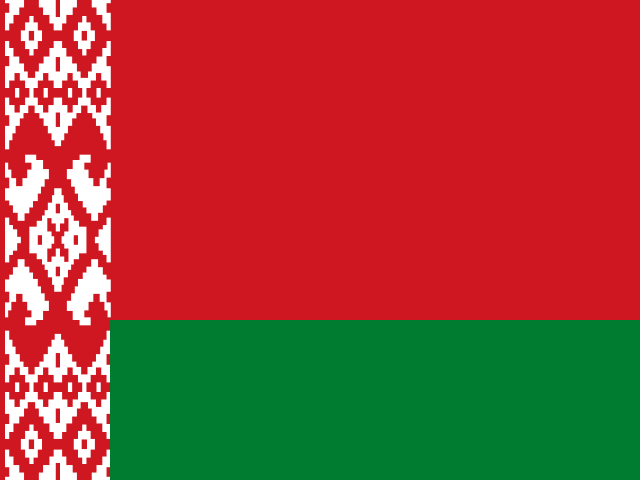
- Description: red horizontal band (top), with a green horizontal band below that is half the width of the red band; a white vertical stripe on the left side has traditional Belarusian designs in redMeaning: the red stands for past struggles to escape oppression, and the green for hope and the country's forests
- National symbols
- no official symbol; the mounted knight known as Pahonia (the Chaser) is the traditional symbol
- National colours
- green, red, white
- National anthem
- Title: "My, Bielarusy" (We Belarusians)Lyrics/music: Mikhas KLIMKOVICH and Uladzimir KARYZNA/Nester SAKALOUSKIHistory: music adopted 1955, lyrics adopted 2002; after the fall of the Soviet Union, Belarus kept the music of its Soviet-era anthem but adopted new lyrics; also known as "Dziarzauny himn Respubliki Bielarus" (State Anthem of the Republic of Belarus)
- UNESCO World Heritage Sites
- Total World Heritage Sites: 4 (3 cultural, 1 natural)Selected World Heritage Site locales: Białowieża Forest (n); Mir Castle Complex (c); Architectural, Residential, and Cultural Complex of the Radziwill Family at Nesvizh (c)
Economy
- Overview
- declining Russian energy subsidies will end in 2024; growing public debt; strong currency pressures have led to higher inflation; recent price controls on basic food and drugs; public sector wage increases and fragile private sector threaten household income gains and economic growth
- GDP (PPP)
- $265.22 billion (2024 est.)
- GDP per person (PPP)
- $29,000 (2024 est.)
- GDP growth
- 4% (2024 est.)
- Inflation
- 5.8% (2024 est.)
- Unemployment
- 3.4% (2024 est.)
- Below poverty line
- 3.9% (2022 est.)
- Farm products
- milk, sugar beets, potatoes, wheat, triticale, barley, maize, rapeseed, rye, chicken (2023)
- Industries
- metal-cutting machine tools, tractors, trucks, earthmovers, motorcycles, synthetic fibers, fertilizer, textiles, refrigerators, washing machines and other household appliances
- Exports
- $49.386 billion (2024 est.)
- Main exports
- fertilizers, rapeseed oil, wood, poultry, beef (2023)
- Export partners
- China 34%, Kazakhstan 10%, Uzbekistan 7%, Poland 6%, Brazil 5% (2023)
- Main imports
- cars, broadcasting equipment, fabric, plastic products, video displays (2023)
- Import partners
- China 33%, Poland 16%, Germany 11%, Lithuania 10%, Turkey 9% (2023)
- Money sent home from abroad
- 1.8% of GDP (2024 est.)
Energy, internet and transport
- Electricity access
- Electrification - total population: 100% (2022 est.)
- Electricity sources
- Fossil fuels: 70% of total installed capacity (2023 est.)Nuclear: 26.9% of total installed capacity (2023 est.)Solar: 0.5% of total installed capacity (2023 est.)Wind: 0.4% of total installed capacity (2023 est.)Hydroelectricity: 0.9% of total installed capacity (2023 est.)Biomass and waste: 1.2% of total installed capacity (2023 est.)
- Internet users
- Percent of population: 92% (2023 est.)
- Mobile phones
- Total subscriptions: 11.9 million (2024 est.)Subscriptions per 100 inhabitants: 131 (2024 est.)
- TV and radio
- 7 state-controlled national TV channels; Polish and Russian TV broadcasts are available in some areas; state-run Belarusian Radio operates 5 national networks and an external service; Russian and Polish radio broadcasts are available (2019)
- Airports
- 46 (2025)
- Railways
- Total: 5,528 km (2014)Standard gauge: 25 km (2014) 1.435-m gaugeBroad gauge: 5,503 km (2014) 1.520-m gauge (874 km electrified)
- Merchant ships
- Total: 4 (2023)By type: other 4
Military and space
- Armed forces
- Belarus Armed Forces: Army, Air and Air Defense Force, Special Operations Force, Special Troops, Territorial Defense ForcesMinistry of Interior: State Border Troops, Militia, Internal Troops (2025)
- Military spending
- 2% of GDP (2024 est.)
- Military service
- 18-27 years of age for compulsory military or alternative service; conscript service obligation is 12-18 months, depending on academic qualifications, and 24-36 months for alternative service; 17-year-olds are eligible to become cadets at military higher education institutes, where they are classified as military personnel (2025)
Global issues
- Refugees and displaced people
- Refugees: 44,621 (2024 est.)Stateless persons: 5,620 (2024 est.)
Neighbouring countries
LatviaLithuaniaPolandRussiaUkraine
- Phone code
- +375
- Internet domain
- .by