Pakistan
Islamic Republic of Pakistan · پاكستان
Home of the Indus Valley city of Mohenjo-daro. Created at partition as a Muslim homeland; East Pakistan became Bangladesh in 1971. A nuclear power with long periods of military rule.
See Pakistan on the 3D globeTake a quiz
Population251 million
Area881,912 km²
CapitalIslamabad
RegionSouthern Asia
Did you know?
- Has five of the world's 14 peaks over 8,000 m
- Mohenjo-daro was one of the world's first cities
- Malala Yousafzai became the youngest Nobel laureate
Key facts about Pakistan
- Government
- Federal parliamentary republic (strong military influence)
- Religion
- Islam ~96% (mostly Sunni)
- Founded / independence
- 1947 (from British India)
- Rich in
- Textiles, cotton, agriculture, nuclear power; mediated US–Iran deal 2026
- Languages
- English, Urdu
Urdu and English; Punjabi, Pashto, Sindhi, Saraiki, Balochi - Currency
- Pakistani rupee (₨)
- People are called
- Pakistani
- Main cities
- Karachi, Lahore, Faisalabad, Rawalpindi, Islamabad, Peshawar
Timeline of Pakistan
- 2500 BCIndus Valley cities
- 1526Mughal Empire
- 1947Independence
- 1971Bangladesh secedes
- 1998Nuclear tests
- 2025Clashes with India
Places to see in Pakistan
- Badshahi Mosque
- Lahore Fort
- Mohenjo-daro
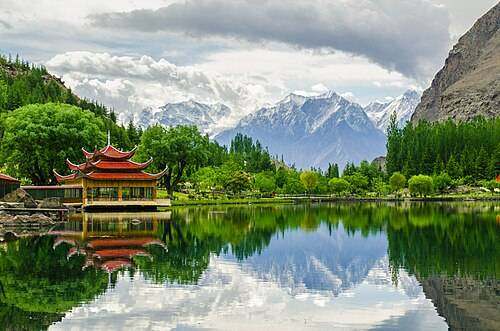
- Hunza Valley
- Karakoram Highway
- Faisal Mosque
Food and drink
Biryani · nihari · karahi · chapli kebab
Culture and famous for
Qawwali music; truck art; poet Iqbal
Popular sports
Cricket, field hockey, squash
Geography and climate
- Highest point
- K2, 8,611 m (world's second-highest)
- Rivers, lakes and seas
- Indus
- Climate
- Arid to alpine
- Coastline
- Has a sea coast
- Population density
- 285 people per km²
Wars and conflicts
- Wars with India 1947, 1965, 1971, 1999
- 2025 India clashes
- Taliban and Baloch insurgencies
- Afghan border clashes 2025
Empires and states that once stood here
Indus Valley Civilisation c. 3300–1300 BCMughal Empire 1526–1857Sikh Empire 1799–1849
Alliances and memberships
Military and security
Shanghai Cooperation Organisation
Political unions and regional organisations
SAARCOrganisation of Islamic CooperationCommonwealth of Nations
Defence treaties
- Saudi Arabia–Pakistan Strategic Mutual Defence Agreement (2025): Aggression against either country is treated as aggression against both.
Pakistan in depth
Detailed facts from the CIA World Factbook (public domain, latest edition).
Overview
- History in brief
- The Indus Valley civilization, one of the oldest in the world and dating back at least 5,000 years, spread over much of modern-day Pakistan. During the second millennium B.C., remnants of this culture fused with the migrating Indo-Aryan peoples. The area underwent successive invasions in subsequent centuries from the Persians, Greeks, Scythians, Arabs (who brought Islam), Afghans, and Turks. The Mughal Empire flourished in the 16th and 17th centuries; the British came to dominate the region in the 18th century. The partition in 1947 of British India into the Muslim state of Pakistan (with West and East sections) and largely Hindu India created lasting tension between the two countries. They have fought two wars and a limited conflict -- in 1947-48, 1965, and 1999 respectively -- over the Kashmir territory, a dispute that continues to this day. A third war in 1971 -- in which India assisted an indigenous movement reacting to Bengali marginalization in Pakistani politics -- resulted in East Pakistan becoming the separate nation of Bangladesh. In response to Indian nuclear weapons testing, Pakistan conducted its own tests in 1998. Pakistan has been engaged in a decades-long armed conflict with militant groups, including the Tehreek-e-Taliban Pakistan (TTP) and other militant networks that target government institutions and civilians.
Geography
- Location
- Southern Asia, bordering the Arabian Sea, between India on the east and Iran and Afghanistan on the west and China in the north
- Size compared
- slightly more than five times the size of Georgia; slightly less than twice the size of California
- Land borders
- Total: 7,257 kmBorder countries: Afghanistan 2,670 km; China 438 km; India 3,190 km; Iran 959 km
- Coastline
- 1,046 km
- Climate
- mostly hot, dry desert; temperate in northwest; arctic in north
- Terrain
- Divided into three major geographic areas: the northern highlands, the Indus River plain in the center and east, and the Balochistan Plateau in the south and west
- Elevation
- Highest point: K2 (Mt. Godwin-Austen) 8,611 mLowest point: Arabian Sea 0 mMean elevation: 900 m
- Natural resources
- arable land, extensive natural gas reserves, limited petroleum, poor quality coal, iron ore, copper, salt, limestone
- Major rivers
- Indus river mouth (shared with China [s] and India) - 3,610 km; Sutlej river mouth (shared with China [s] and India) - 1,372 km; Chenab river mouth (shared with India [s]) - 1,086 kmNote: [s] after country name indicates river source; [m] after country name indicates river mouth
- Natural hazards
- frequent earthquakes, occasionally severe especially in north and west; flooding along the Indus after heavy rains (July and August)
- Notes
- controls Khyber Pass and Bolan Pass, traditional invasion routes between Central Asia and India
- Environmental issues
- water pollution from raw sewage, industrial wastes, and agricultural runoff; limited natural freshwater resources; most of the population does not have access to potable water; deforestation; soil erosion; desertification; air pollution and noise pollution in urban areas
People and society
- Population
- Total: 257,047,044 (2025 est.)Male: 130,727,015Female: 126,320,029
- Nationality
- Noun: Pakistani(s)Adjective: Pakistani
- Ethnic groups
- Punjabi 44.7%, Pashtun (Pathan) 15.4%, Sindhi 14.1%, Saraiki 8.4%, Muhajirs 7.6%, Baloch 3.6%, other 6.3%
- Languages
- Punjabi 38.8%, Pashto (alternate name, Pashtu) 18.2%, Sindhi 14.6%, Saraiki (a Punjabi variant) 12.2%, Urdu 7.1%, Balochi 3%, Hindko 2.4%, Brahui 1.2%, other 2.4%Major-language sample(s): دنیا کا قاموس، ایک لازمی زریہ بنیادی معلومات کا (Urdu)The World Factbook, the indispensable source for basic information.
- Religions
- Muslim 96.4%, Hindu 1.6%, Christian 1.4%; less than 1%: scheduled castes, Qadiani/Ahmadi, other, Sikh. (2020 est.)
- Median age
- Total: 23.2 years (2025 est.)Male: 22.8 yearsFemale: 23 years
- Population growth
- 1.82% (2025 est.)
- Life expectancy
- Total population: 70.3 years (2024 est.)Male: 68.2 yearsFemale: 72.5 years
- Children per woman
- 3.25 children born/woman (2025 est.)
- Urbanization
- Urban population: 38% of total population (2023)Rate of urbanization: 2.1% annual rate of change (2020-25 est.)
- Largest cities
- 17.236 million Karachi, 13.979 million Lahore, 3.711 million Faisalabad, 2.415 million Gujranwala, 2.412 million Peshawar, 1.232 million ISLAMABAD (capital) (2023)
- Literacy
- Total population: 58.9% (2021 est.)Male: 69.1% (2021 est.)Female: 48.5% (2021 est.)
- Years in school
- Total: 8 years (2022 est.)Male: 8 years (2022 est.)Female: 7 years (2022 est.)
Government
- Official names
- Conventional long form: Islamic Republic of PakistanConventional short form: PakistanLocal long form: Jamhuryat Islami PakistanLocal short form: PakistanFormer: West PakistanEtymology: the name is said to have been proposed in the early 1930s by Muslim students at Cambridge University, created from the initials of Punjab, Afghanistan, and Kashmir; the word pak also means "pure" in Persian or Pashto, and the Persian suffix -stan means "place of" or "country," so Pakistan literally means "Land of the Pure"
- Government type
- federal parliamentary republic
- Capital
- Name: IslamabadGeographic coordinates: 33 41 N, 73 03 ETime difference: UTC+5 (10 hours ahead of Washington, DC, during Standard Time)Etymology: the name means "city of Islam" and derives from the Arabic islam, referring to the Islamic faith, and the Persian suffix -abad, meaning "inhabited place" or "city"
- Regions
- 4 provinces, 2 Pakistan-administered areas*, and 1 capital territory**; Azad Kashmir*, Balochistan, Gilgit-Baltistan*, Islamabad Capital Territory**, Khyber Pakhtunkhwa, Punjab, Sindh
- Independence
- 14 August 1947 (from British India)
- National holiday
- Pakistan Day, 23 March, also referred to as Pakistan Resolution Day (1940) or Republic Day (1956)
- Constitution
- History: several previous; latest endorsed 12 April 1973, passed 19 April 1973, entered into force 14 August 1973 (suspended and restored several times)Amendment process: proposed by the Senate or by the National Assembly; passage requires at least two-thirds majority vote of both houses
- Legal system
- common law system with Islamic law influence
- Voting age
- 18 years of age; universal
- Flag meaning
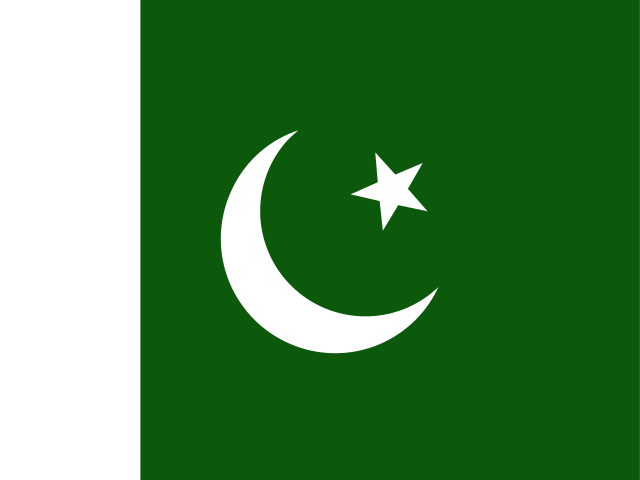
- Description: green with a vertical white band on the left side; a large white crescent and star are centered in the green fieldMeaning: the crescent, star, and color green are all traditional Islamic symbols; the white band symbolizes the role of religious minorities
- National symbols
- five-pointed star between the horns of a waxing crescent moon, jasmine
- National colours
- green, white
- National anthem
- Title: "Qaumi Tarana" (National Anthem)Lyrics/music: Abu-Al-Asar Hafeez JULLANDHURI/Ahmed Ghulamali CHAGLAHistory: adopted 1954; also known as "Pak sarzamin shad bad" (Blessed Be the Sacred Land)
- UNESCO World Heritage Sites
- Total World Heritage Sites: 6 (all cultural)Selected World Heritage Site locales: Archaeological Ruins at Moenjodaro; Buddhist Ruins of Takht-i-Bahi; Taxila; Fort and Shalamar Gardens in Lahore; Historical Monuments at Makli, Thatta; Rohtas Fort
Economy
- Overview
- lower middle-income South Asian economy; extremely high debt; endemic corruption; regional disputes with India and Afghanistan hinder investment; falling inflation, IMF relief programs, and strong agricultural output slowly contributing to economic recovery
- GDP (PPP)
- $1.39 trillion (2024 est.)
- GDP per person (PPP)
- $5,500 (2024 est.)
- GDP growth
- 3.2% (2024 est.)
- Inflation
- 12.6% (2024 est.)
- Unemployment
- 5.5% (2024 est.)
- Below poverty line
- 21.9% (2018 est.)
- Farm products
- sugarcane, bison milk, wheat, milk, rice, maize, potatoes, cotton, mangoes/guavas, chicken (2023)
- Industries
- textiles and apparel, food processing, pharmaceuticals, surgical instruments, construction materials, paper products, fertilizer, shrimp
- Exports
- $40.219 billion (2024 est.)
- Main exports
- garments, fabric, refined petroleum, rice, cotton fabric (2023)
- Export partners
- USA 14%, UAE 10%, China 9%, Germany 7%, UK 6% (2023)
- Main imports
- natural gas, refined petroleum, crude petroleum, palm oil, plastics (2023)
- Import partners
- China 25%, Qatar 11%, UAE 9%, Saudi Arabia 8%, Indonesia 6% (2023)
- Money sent home from abroad
- 9.4% of GDP (2024 est.)
Energy, internet and transport
- Electricity access
- Electrification - total population: 95% (2022 est.)Electrification - urban areas: 100%Electrification - rural areas: 93%
- Electricity sources
- Fossil fuels: 60.4% of total installed capacity (2023 est.)Nuclear: 14.1% of total installed capacity (2023 est.)Solar: 0.7% of total installed capacity (2023 est.)Wind: 3.7% of total installed capacity (2023 est.)Hydroelectricity: 19.9% of total installed capacity (2023 est.)Biomass and waste: 1.1% of total installed capacity (2023 est.)
- Internet users
- Percent of population: 27% (2023 est.)
- Mobile phones
- Total subscriptions: 193 million (2024 est.)Subscriptions per 100 inhabitants: 77 (2024 est.)
- TV and radio
- 120 satellite TV stations; 42 media companies/channels; state-run Pakistan Television Corporation (PTV) is the largest TV network, serves over 85 percent of the population with 9 TV channels; over 100 private cable and satellite channels; state-owned Pakistan Broadcasting Corporation (PBC or Radio Pakistan) has the largest radio audience, particularly in rural areas, with AM/SW/FM stations covering most of the country (2022)
- Airports
- 117 (2025)
- Railways
- Total: 11,881 km (2021)Narrow gauge: 389 km (2021) 1.000-m gaugeBroad gauge: 11,492 km (2021) 1.676-m gauge (286 km electrified)
- Merchant ships
- Total: 60 (2023)By type: bulk carrier 5, oil tanker 9, other 46
Military and space
- Armed forces
- Pakistan Armed Forces: Pakistan Army (includes National Guard), Pakistan Navy (includes Pakistan Marines, Pakistan Maritime Security Agency), Pakistan Air ForceMinistry of Interior: Frontier Constabulary, Frontier Corps, National Police, Pakistan Coast Guard, Punjab (Pakistan) Rangers, Sindh (Pakistan) Rangers (2025)
- Military spending
- 2.5% of GDP (2024 est.)
- Military service
- 16-28 years of age for voluntary military service for men and women; lower and upper age limits vary by military branch, position, and role; personnel cannot be deployed for combat until age 18 (2025)
- Space programme
- space program dates back to the early 1960s, but funding shortfalls and shifts in priority toward ballistic missile development in the 1980s and 1990s hampered the program’s development; now has a strengthened focus on acquiring satellites and reaching agreements with other space powers for additional capabilities; manufactures and operates satellites; researching and developing other space-related capabilities and technologies, such as satellite payloads; also conducts research in areas such as astronomy, astrophysics, environmental monitoring, and space sciences; works with China, Russia, and Turkey (cooperated with the UK and US prior to the 1990s) (2025)
- Space milestones
- 1962-1972 - launched about 200 sounding rockets with some US assistance1990 - first domestically built experimental satellite (Badr-1) launched by China2001 - first remote sensing (RS) satellite (Badr-2) built jointly with the UK and launched by Russia2011 - first digital communications satellite (PakSat-1R) launched by China2017 - successfully test-launched ballistic missile system (Shaheed-III)2023 - joined China’s International Lunar Research Station program2024 - first lunar orbiter/satellite (iCube Qamar) launched by China and deployed from China's Chang'e-6 spacecraft2025 - first fully domestic RS satellite (PRSC-EO1) launched by China; selected country's first astronauts to be trained by China for mission to China's space station
Global issues
- Refugees and displaced people
- Refugees: 1,759,332 (2024 est.)IDPs: 224,813 (2024 est.)Stateless persons: 60 (2024 est.)
- Drug trade
- USG identification: major illicit drug-producing and/or drug-transit countrymajor precursor-chemical producer (2025)
Neighbouring countries
- Phone code
- +92
- Internet domain
- .pk