Afghanistan
Islamic Republic of Afghanistan · افغانستان · Owganystan
Crossroads of empires from Alexander to the Mughals. Modern state founded by Ahmad Shah Durrani in 1747. Decades of war followed the 1978 communist coup; the Taliban returned to power in 2021 and bar girls from secondary school.
See Afghanistan on the 3D globeTake a quiz
Population42 million
Area652,230 km²
CapitalKabul
RegionSouthern Asia
Did you know?
- The Bamiyan Buddhas were among the world's largest standing Buddha statues
- Afghan cricket rose from refugee camps to the World Cup
- The Wakhan Corridor touches China
Key facts about Afghanistan
- Government
- Islamic emirate under the Taliban (theocracy, recognised only by Russia)
- Religion
- Sunni Islam ~85%, Shia ~15%
- Founded / independence
- 1747 (Durrani Empire); 1919 full independence
- Rich in
- Lithium, copper, iron, rare earths (largely untapped), saffron
- Languages
- Dari, Pashto, Turkmen
Pashto and Dari (Persian); Uzbek, Turkmen, Hazaragi, Balochi - Currency
- Afghan afghani (؋)
- People are called
- Afghan
- Main cities
- Kabul, Kandahar, Herat, Mazar-i-Sharif
Timeline of Afghanistan
- 1747Durrani Empire
- 1919Full independence
- 1973Monarchy ends
- 1979Soviet invasion
- 1996First Taliban rule
- 2001US-led invasion
- 2021Taliban return
Places to see in Afghanistan
- Band-e Amir lakes
- Minaret of Jam
- Herat Citadel
- Blue Mosque of Mazar-i-Sharif
- Bamiyan valley (giant Buddhas destroyed 2001)
Food and drink
Kabuli pulao · mantu dumplings · bolani · naan
Culture and famous for
Carpets; Persian poetry (Rumi was born in Balkh); lapis lazuli mining for 6,000 years
Popular sports
Cricket, buzkashi (horseback goat-carcass game)
Geography and climate
- Highest point
- Noshaq, 7,492 m
- Rivers, lakes and seas
- Amu Darya, Helmand, Kabul River
- Climate
- Arid continental; very cold winters
- Coastline
- Landlocked
- Population density
- 64 people per km²
Wars and conflicts
- Anglo-Afghan wars
- Soviet war 1979–89
- civil war
- US-led war 2001–21
Empires and states that once stood here
Alliances and memberships
Military and security
Shanghai Cooperation Organisation (observer)
Political unions and regional organisations
SAARCOrganisation of Islamic Cooperation
Afghanistan in depth
Detailed facts from the CIA World Factbook (public domain, latest edition).
Overview
- History in brief
- Ahmad Shah DURRANI unified the Pashtun tribes and founded Afghanistan in 1747. The country served as a buffer between the British and Russian Empires until it won independence from notional British control in 1919. A brief experiment in increased democracy ended in a 1973 coup and a 1978 communist countercoup. The Soviet Union invaded in 1979 to support the tottering Afghan communist regime, touching off a long and destructive war. Internationally supported anti-communist mujahidin rebels forced the USSR to withdraw in 1989. A series of subsequent civil wars saw Kabul finally fall in 1996 to the Taliban, a hardline Pakistani-sponsored movement. Following the 11 September 2001 terrorist attacks, a US and Allied military action toppled the Taliban for sheltering Usama BIN LADIN. A UN-sponsored Bonn Conference in 2001 established a process for political reconstruction that included the adoption of a new constitution, a presidential election in 2004, and National Assembly elections in 2005. In 2004, Hamid KARZAI became the first democratically elected president of Afghanistan, and he was reelected in 2009. Ashraf Ghani AHMADZAI succeeded him as president in 2014 following a disputed election. The Taliban conducted an insurgency for two decades against the Afghan Government and forces from the United States and other countries. In February 2020, the US and the Taliban signed an agreement that led to the withdrawal of international forces in exchange for commitments on counterterrorism and other assurances. The Taliban took over Afghanistan on 15 August 2021.The Taliban established an all-male interim leadership structure dominated by Pashtun clerics under the leadership of Haivatrullah AKHUNDZADA. The Taliban issued numerous edicts that constrained women's mobility, ability to study and work, and access to education beyond primary school. To date, no country has recognized the Taliban as the government of Afghanistan.
Geography
- Location
- Southern Asia, north and west of Pakistan, east of Iran
- Size compared
- almost six times the size of Virginia; slightly smaller than Texas
- Land borders
- Total: 5,987 kmBorder countries: China 91 km; Iran 921 km; Pakistan 2,670 km; Tajikistan 1,357 km; Turkmenistan 804 km; Uzbekistan 144 km
- Coastline
- 0 km (landlocked)
- Climate
- arid to semiarid; cold winters and hot summers
- Terrain
- mostly rugged mountains; plains in north and southwest
- Elevation
- Highest point: Noshak 7,492 mLowest point: Amu Darya 258 mMean elevation: 1,884 m
- Natural resources
- natural gas, petroleum, coal, copper, chromite, talc, barites, sulfur, lead, zinc, iron ore, salt, precious and semiprecious stones, arable land
- Major rivers
- Amu Darya (shared with Tajikistan [s], Turkmenistan, and Uzbekistan [m]) - 2,620 km; Helmand river source (shared with Iran) - 1,130 kmNote: [s] after country name indicates river source; [m] after country name indicates river mouth
- Major lakes
- Salt water lake(s): Ab-e Istadah-ye Muqur (endorheic basin) - 520 sq km
- Natural hazards
- damaging earthquakes occur in Hindu Kush mountains; flooding; droughts
- Notes
- landlocked; the Hindu Kush mountains that run northeast to southwest divide the northern provinces from the rest of the country; the highest peaks are in the northern Vakhan (Wakhan Corridor)
- Environmental issues
- limited natural freshwater resources; inadequate potable water; soil degradation; overgrazing; deforestation (cut down for fuel and building materials); desertification; air and water pollution in urban areas
People and society
- Population
- Total: 49,474,805 (2025 est.)Male: 25,051,967Female: 24,422,838
- Nationality
- Noun: Afghan(s)Adjective: Afghan
- Ethnic groups
- current, reliable statistical data on ethnicity in Afghanistan are not available; Afghanistan's 2004 Constitution cited Pashtun, Tajik, Hazara, Uzbek, Turkman, Baluch, Pashaie, Nuristani, Aymaq, Arab, Qirghiz, Qizilbash, Gujur, and Brahwui ethnicities; Afghanistan has dozens of other small ethnic groups
- Languages
- Afghan Persian or Dari (official, lingua franca) 77%, Pashto (official) 48%, Uzbeki 11%, English 6%, Turkmani 3%, Urdu 3%, Pashaie 1%, Nuristani 1%, Arabic 1%, Balochi 1%, other <1% (2020 est.)Major-language sample(s): کتاب حقایق جهان، مرجعی ضروری برای اطلاعات اولیە (Dari) د دنیا د حقائېقو کتاب، بنیادی معلوماتو لپاره ضروری سرچینه- (Pashto)The World Factbook, the indispensable source for basic information.
- Religions
- Muslim 99.7% (Sunni 84.7 - 89.7%, Shia 10 - 15%), other <0.3% (2009 est.)
- Median age
- Total: 18.4 years (2025 est.)Male: 20 yearsFemale: 20.1 years
- Population growth
- 2.86% (2025 est.)
- Life expectancy
- Total population: 54.4 years (2024 est.)Male: 52.8 yearsFemale: 56.1 years
- Children per woman
- 4.89 children born/woman (2025 est.)
- Urbanization
- Urban population: 26.9% of total population (2023)Rate of urbanization: 3.34% annual rate of change (2020-25 est.)
- Largest cities
- 4.589 million KABUL (capital) (2023)
- Literacy
- Total population: 37.3% (2021 est.)Male: 52.1% (2021 est.)Female: 26.6% (2022 est.)
- Years in school
- Total: 11 years (2018 est.)Male: 13 years (2018 est.)Female: 8 years (2018 est.)
Government
- Official names
- Conventional long form: Islamic Republic of Afghanistan (prior to 15 August 2021); current country name disputedConventional short form: AfghanistanLocal long form: Jamhuri-ye Islami-ye Afghanistan (prior to 15 August 2021; current country name is disputed)Local short form: AfghanistanEtymology: the name "Afghan" originally referred to the Pashtun people, but today it is understood to include all the country's ethnic groups; the suffix "-stan" means "place of" or "country," so Afghanistan literally means the "Land of the Afghans"
- Government type
- theocratic; the United States does not recognize the Taliban Government
- Capital
- Name: KabulGeographic coordinates: 34 31 N, 69 11 ETime difference: UTC+4.5 (9.5 hours ahead of Washington, DC, during Standard Time)Daylight saving time: does not observe daylight savings timeEtymology: named for the Kabul River, but the river's name is of unknown origin
- Regions
- 34 provinces (welayat, singular - welayat); Badakhshan, Badghis, Baghlan, Balkh, Bamyan, Daykundi, Farah, Faryab, Ghazni, Ghor, Helmand, Herat, Jowzjan, Kabul, Kandahar, Kapisa, Khost, Kunar, Kunduz, Laghman, Logar, Nangarhar, Nimroz, Nuristan, Paktika, Paktiya, Panjshir, Parwan, Samangan, Sar-e Pul, Takhar, Uruzgan, Wardak, Zabul
- Independence
- 19 August 1919 (from UK control over Afghan foreign affairs)
- National holiday
- Previous: Independence Day, 19 August (1919); under the Taliban Government, 15 August (2022) is declared a national holiday, marking the anniversary of the victory of the Afghan jihad
- Constitution
- History: several previous; latest ratified in 2004, but not currently enforced by the Taliban
- Legal system
- the Taliban is implementing its own interpretation of Islamic law, which is partially based on the Hanifi school of Islamic jurisprudence and have enforced strict punishments; before the Taliban takeover, Afghanistan had a mixed legal system of civil, customary, and Islamic law (2021)
- Voting age
- 18 years of age; universal
- Flag meaning
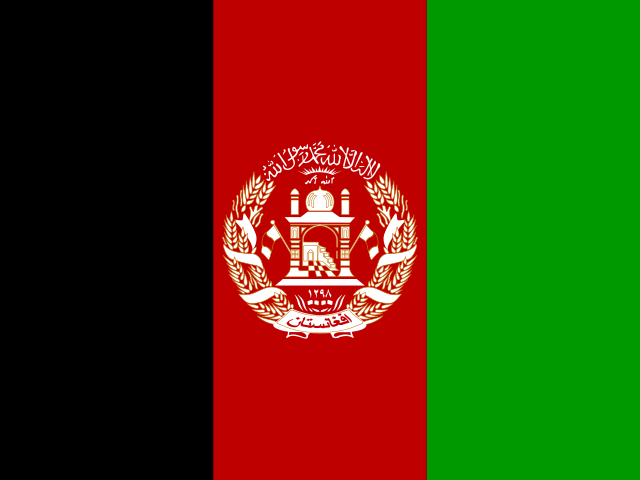
- Description: three equal vertical bands of black (left), red, and green, with the national emblem in white centered on the red band and slightly overlapping the other bands; the emblem shows a mosque with a pulpit and flags on either side; below the mosque are Eastern Arabic numerals for the solar year 1298 (1919 in the Gregorian calendar, the year of Afghan independence from the UK); a border of wheat sheaves circles the mosque; above the mosque is an Arabic inscription of the Shahada (Muslim creed), with rays of the rising sun over the Takbir (Arabic expression meaning "God is great"); under the mosque is a scroll with the name AfghanistanMeaning: black stands for the past, and red for the blood shed for independence; green can represent hope for the future, agricultural prosperity, or IslamHistory: Afghanistan had more changes to its national flag in the 20th century -- 19 by one count -- than any other country; the colors black, red, and green appeared on most of them
- National symbols
- lion
- National colours
- red, green, black
- National anthem
- Title: "Milli Surood" (National Anthem)Lyrics/music: Abdul Bari JAHANI/Babrak WASAHistory: adopted 2006
- UNESCO World Heritage Sites
- Total World Heritage Sites: 2 (both cultural)Selected World Heritage Site locales: Minaret of Jam; Buddhas of Bamyan
Economy
- Overview
- low-income South Asian economy; economy stable after major contraction due to Taliban takeover, but recovery remains fragile; widespread poverty and obstacles to human development; import-reliant for food, fuel, and machinery; ongoing sanctions, suspended development aid, and frozen reserve assets
- GDP (PPP)
- $82.238 billion (2023 est.)
- GDP per person (PPP)
- $2,000 (2023 est.)
- GDP growth
- 2.3% (2023 est.)
- Inflation
- -6.6% (2024 est.)
- Unemployment
- 13.3% (2024 est.)
- Below poverty line
- 54.5% (2016 est.)
- Farm products
- wheat, milk, grapes, watermelons, potatoes, cantaloupes/melons, vegetables, rice, onions, maize (2023)
- Industries
- small-scale production of bricks, textiles, soap, furniture, shoes, fertilizer, apparel, food products, non-alcoholic beverages, mineral water, cement; handwoven carpets; natural gas, coal, copper
- Exports
- $1.476 billion (2020 est.)
- Main exports
- coal, grapes, tropical fruits, gum resins, other nuts (2023)
- Export partners
- Pakistan 42%, India 40%, China 4%, UAE 2%, Turkey 2% (2023)
- Main imports
- wheat flours, tobacco, palm oil, broadcasting equipment, synthetic fabric (2023)
- Import partners
- UAE 28%, Pakistan 15%, China 15%, Uzbekistan 12%, Kazakhstan 9% (2023)
- Money sent home from abroad
- 1.9% of GDP (2023 est.)
Energy, internet and transport
- Electricity access
- Electrification - total population: 85.3% (2022 est.)Electrification - urban areas: 95.9%Electrification - rural areas: 81.7%
- Electricity sources
- Fossil fuels: 13.3% of total installed capacity (2023 est.)Solar: 9.7% of total installed capacity (2023 est.)Hydroelectricity: 77% of total installed capacity (2023 est.)
- Internet users
- Percent of population: 18% (2023 est.)
- Mobile phones
- Total subscriptions: 25.6 million (2024 est.)Subscriptions per 100 inhabitants: 60 (2024 est.)
- TV and radio
- under the Taliban, independent media outlets have decreased and are probably self-censoring; the Ministry of Information and Culture monitors all mass media; television and radio are key media platforms; only about a fifth of Afghans use the internet, mostly through smartphones (2023)
- Airports
- 68 (2025)
Military and space
- Armed forces
- the Taliban claims authority over a Ministry of Defense and a National Army (aka Army of the Islamic Emirate of Afghanistan, Islamic Emirate Army, or Afghan Army); it has also formed police forces under a Ministry of Interior (2025)
- Military spending
- 3.3% of GDP (2019)
- Military service
- service is voluntary; there is no conscription (2023)
Global issues
- Refugees and displaced people
- Refugees: 21,236 (2024 est.)IDPs: 5,457,183 (2024 est.)
- Drug trade
- USG identification: major illicit drug-producing and/or drug-transit countrymajor precursor-chemical producer (2025)
Neighbouring countries
IranPakistanTurkmenistanUzbekistanTajikistanChina
- Phone code
- +93
- Internet domain
- .af