Israel
State of Israel · إسرائيل · ישראל
Land of ancient Israel and Judah. Founded in 1948 after the Holocaust; the war displaced about 700,000 Palestinians. Since the Hamas attack of 7 October 2023 it fought Hamas, Hezbollah and Iran; a fragile Gaza ceasefire began in October 2025.
See Israel on the 3D globeTake a quiz
Ongoing: Gaza war, US–Israel war with Iran, Yemen civil war
Population10 million
Area20,770 km²
CapitalJerusalem
RegionWestern Asia
Did you know?
- The Dead Sea is the lowest point on land (about 430 m below sea level)
- Revived Hebrew as a spoken language
- Has more startups per person than almost any country
Key facts about Israel
- Government
- Parliamentary republic
- Religion
- Judaism ~73%, Islam ~18%, Christian ~2%, Druze ~2%
- Founded / independence
- 1948
- Rich in
- High-tech, cybersecurity, diamonds, defence
- Languages
- Arabic, Hebrew
Hebrew (revived as a spoken language), Arabic; Russian, Amharic, English - Currency
- Israeli new shekel (₪)
- People are called
- Israeli
- Main cities
- Jerusalem, Tel Aviv, Haifa, Rishon LeZion, Be'er Sheva
Timeline of Israel
- 1000 BCKingdom of David
- 70Romans destroy the Temple
- 1948Independence
- 1967Six-Day War
- 1979Peace with Egypt
- 1994Peace with Jordan
- 2023Hamas attack and Gaza war
Places to see in Israel
- Western Wall
- Church of the Holy Sepulchre
- Dome of the Rock
- Masada
- Dead Sea
- Tel Aviv's White City
Food and drink
Falafel · hummus · shakshuka · sabich
Culture and famous for
Holy sites of Judaism, Christianity and Islam; startup and tech culture
Popular sports
Football, basketball
Geography and climate
- Highest point
- Mount Meron, 1,208 m (Mount Hermon in occupied Golan is higher)
- Rivers, lakes and seas
- Jordan River; Sea of Galilee; Dead Sea
- Climate
- Mediterranean to desert
- Coastline
- Has a sea coast
- Population density
- 481 people per km²
Wars and conflicts
- 1948 war
- Suez 1956
- Six-Day War 1967
- Yom Kippur 1973
- Lebanon wars
- Gaza war 2023–25
- Iran wars 2025–26
Empires and states that once stood here
Kingdom of Jerusalem 1099–1291
Alliances and memberships
Economy and trade
Israel in depth
Detailed facts from the CIA World Factbook (public domain, latest edition).
Overview
- History in brief
- Israel has become a regional economic and military powerhouse, leveraging its prosperous high-tech sector, large defense industry, and concerns about Iran to foster partnerships around the world. The State of Israel was established in 1948. The UN General Assembly proposed in 1947 partitioning the British Mandate for Palestine into an Arab and Jewish state. The Jews accepted the proposal, but the local Arabs and the Arab states rejected the UN plan and launched a war. The Arabs were subsequently defeated in the 1947-1949 war that followed the UN proposal and the British withdrawal. Israel joined the UN in 1949 and saw rapid population growth, primarily due to Jewish refugee migration from Europe and the Middle East. Israel and its Arab neighbors fought wars in 1956, 1967, and 1973, and Israel signed peace treaties with Egypt in 1979 and Jordan in 1994. Israel took control of the West Bank, the eastern part of Jerusalem, the Gaza Strip, the Sinai Peninsula, and the Golan Heights in the course of the 1967 war. It ceded the Sinai back to Egypt in the 1979-1982 period but has continued to administer the other territories through military authorities. Israel and Palestinian officials signed interim agreements in the 1990s that created a period of Palestinian self-rule in parts of the West Bank and Gaza. Israel withdrew from Gaza in 2005. The most recent formal efforts between Israel and the Palestinian Authority to negotiate final status issues occurred in 2013 and 2014, and the US continues its efforts to advance peace. Israel signed the US-brokered normalization agreements (the Abraham Accords) with Bahrain, the UAE, and Morocco in 2020 and reached an agreement with Sudan in 2021. Immigration to Israel continues, with more than 44,000 estimated new immigrants, mostly Jewish, in the first 11 months of 2023.Former Prime Minister Benjamin NETANYAHU returned to office in 2022, continuing his dominance of Israel's political landscape at the head of Israel's most rightwing and religious government. NETANYAHU previously served as premier from 1996 to 1999 and from 2009 to 2021, becoming Israel's longest serving prime minister.On 7 October 2023, HAMAS militants launched a combined unguided rocket and ground terrorist attack from Gaza into southern Israel. The same day Israel’s Air Force launched air strikes inside Gaza and initiated a sustained air campaign against HAMAS targets across the Gaza Strip. The following day, NETANYAHU formally declared war on HAMAS, and
Geography
- Location
- Middle East, bordering the Mediterranean Sea, between Egypt and Lebanon
- Size compared
- slightly larger than New Jersey
- Land borders
- Total: 1,068 kmBorder countries: Egypt 208 km; Gaza Strip 59 km; Jordan 327 km (20 km are within the Dead Sea); Lebanon 81 km; Syria 83 km; West Bank 330 km
- Coastline
- 273 km
- Climate
- temperate; hot and dry in southern and eastern desert areas
- Terrain
- Negev desert in the south; low coastal plain; central mountains; Jordan Rift Valley
- Elevation
- Highest point: Mitspe Shlagim 2,224 m; note - this is the highest named point, the actual highest point is an unnamed dome slightly to the west of Mitspe Shlagim at 2,236 m; both points are on the northeastern border of Israel, along the southern end of the Anti-Lebanon mountain rangeLowest point: Dead Sea -431 mMean elevation: 508 m
- Natural resources
- timber, potash, copper ore, natural gas, phosphate rock, magnesium bromide, clays, sand
- Major lakes
- Salt water lake(s): Dead Sea (shared with Jordan and West Bank) - 1,020 sq kmnote - endorheic hypersaline lake; 9.6 times saltier than the ocean; lake shore is 431 meters below sea level
- Natural hazards
- sandstorms may occur during spring and summer; droughts; periodic earthquakes
- Notes
- Note 1: Lake Tiberias (Sea of Galilee) is an important freshwater source; the Dead Sea is the second saltiest body of water in the world (after Lake Assal in Djibouti)Note 2: the Malham Cave in Mount Sodom is the world's longest salt cave at 10 km (6 mi); Mount Sodom is a hill about 220 m (722 ft) high that is 80% salt, with multiple salt layers covered by a veneer of rock
- Environmental issues
- limited arable land and restricted natural freshwater resources; desertification; air pollution from industrial and vehicle emissions; groundwater pollution from industrial and domestic waste, chemical fertilizers, and pesticides
People and society
- Population
- Total: 9,402,617 (2024 est.)Male: 4,731,275Female: 4,671,342
- Nationality
- Noun: Israeli(s)Adjective: Israeli
- Ethnic groups
- Jewish 73.5% (of which Israel-born 79.7%, Europe/America/Oceania-born 14.3%, Africa-born 3.9%, Asia-born 2.1%), Arab 21.1%, other 5.4% (2022 est.)
- Languages
- Hebrew (official), Arabic (special status under Israeli law), English (most commonly used foreign language)Major-language sample(s): ספר עובדות העולם, המקור החיוני למידע בסיסי (Hebrew)The World Factbook, the indispensable source for basic information.
- Religions
- Jewish 73.5%, Muslim 18.1%, Christian 1.9%, Druze 1.6%, other 4.9% (2022 est.)
- Median age
- Total: 30.2 years (2025 est.)Male: 29.6 yearsFemale: 30.7 years
- Population growth
- 1.59% (2025 est.)
- Life expectancy
- Total population: 83.1 years (2024 est.)Male: 81.1 yearsFemale: 85.1 years
- Children per woman
- 2.89 children born/woman (2025 est.)
- Urbanization
- Urban population: 92.9% of total population (2023)Rate of urbanization: 1.51% annual rate of change (2020-25 est.)
- Largest cities
- 4.421 million Tel Aviv-Yafo, 1.174 million Haifa, 970,000 JERUSALEM (capital) (2023)
- Years in school
- Total: 15 years (2022 est.)Male: 14 years (2022 est.)Female: 16 years (2022 est.)
Government
- Official names
- Conventional long form: State of IsraelConventional short form: IsraelLocal long form: Medinat Yisra'elLocal short form: Yisra'elFormer: Mandatory PalestineEtymology: named after the ancient Kingdom of Israel; according to Biblical tradition, the Jewish patriarch Jacob received the name Israel (meaning "He who struggles with God") after he wrestled with an angel of the Lord
- Government type
- parliamentary democracy
- Capital
- Name: JerusalemGeographic coordinates: 31 46 N, 35 14 ETime difference: UTC+2 (7 hours ahead of Washington, DC, during Standard Time)Daylight saving time: +1hr, Friday before the last Sunday in March; ends the last Sunday in OctoberEtymology: the meaning of the ancient name is unclear; the city is called Ursalim or Urusalimmi in Egyptian texts from the 14th century B.C., which may come from the Western Semitic verb yaru, meaning "to establish," and the name Shalim, the Canaanite god of dusk; another theory says the root letters s-l-m in the name refer to shalom, meaning "peace"
- Regions
- 6 districts (mehozot, singular - mehoz); Central, Haifa, Jerusalem, Northern, Southern, Tel Aviv
- Independence
- 14 May 1948 (following League of Nations mandate under British administration)
- National holiday
- Independence Day, 14 May (1948)
- Constitution
- History: no formal constitution; some functions of a constitution are filled by the Declaration of Establishment (1948), the Basic Laws, and the Law of Return (as amended)Amendment process: proposed by Government of Israel ministers or by the Knesset; passage requires a majority vote of Knesset members and subject to Supreme Court judicial review
- Legal system
- mixed system of English common law, British Mandate regulations, and Jewish, Christian, and Muslim religious laws
- Voting age
- 18 years of age; universal; 17 years of age for municipal elections
- Flag meaning
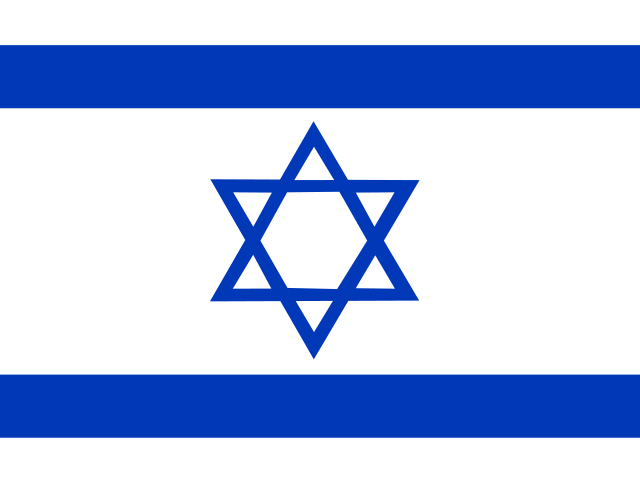
- Description: white with a blue hexagram (six-pointed linear star) known as the Magen David (Star of David or Shield of David) centered between two equal horizontal blue bands near the top and bottom edges of the flagHistory: the design resembles a traditional Jewish prayer shawl (tallit), which is white with blue stripes; the hexagram as a Jewish symbol dates back to medieval times
- National symbols
- Star of David (Magen David), menorah (seven-branched lampstand)
- National colours
- blue, white
- National anthem
- Title: "Hatikvah" (The Hope)Lyrics/music: Naftali Herz IMBER/traditional, arranged by Samuel COHENHistory: adopted 2004, unofficial since 1948; used as the anthem of the Zionist movement since 1897; the 1888 arrangement by Samuel COHEN is thought to be based on the Romanian folk song "Carul cu boi" (The Ox-Driven Cart)
- UNESCO World Heritage Sites
- Total World Heritage Sites: 9 (all cultural)Selected World Heritage Site locales: Masada; Old City of Acre; White City of Tel-Aviv - the Modern Movement; Biblical Tels - Megiddo, Hazor, Beer Sheba; Incense Route - Desert Cities in the Negev; Bahá’i Holy Places; Sites of Human Evolution at Mount Carmel; Caves of Maresha and Bet-Guvrin; Necropolis of Bet She’arim
Economy
- Overview
- high-income, technology- and industrial-based economy; economic contraction and fiscal deficits resulting from war in Gaza; labor force stabilizing following military reservist mobilization; high-tech industry remains resilient while construction and tourism among hardest-hit sectors
- GDP (PPP)
- $472.177 billion (2024 est.)
- GDP per person (PPP)
- $47,300 (2024 est.)
- GDP growth
- 0.9% (2024 est.)
- Inflation
- 3.1% (2024 est.)
- Unemployment
- 3.2% (2024 est.)
- Farm products
- milk, chicken, potatoes, tomatoes, tangerines/mandarins, bananas, eggs, avocados, beef, carrots/turnips (2023)
- Industries
- high-technology products (including aviation, communications, computer-aided design and manufactures, medical electronics, fiber optics), wood and paper products, potash and phosphates, food, beverages, and tobacco, caustic soda, cement, pharmaceuticals, construction, metal products, chemical products, plastics, cut diamonds, textiles, footwear
- Exports
- $153.248 billion (2024 est.)
- Main exports
- integrated circuits, diamonds, broadcasting equipment, medical instruments, refined petroleum (2023)
- Export partners
- USA 29%, China 10%, Ireland 6%, Germany 4%, Hong Kong 4% (2023)
- Main imports
- cars, diamonds, crude petroleum, broadcasting equipment, garments (2023)
- Import partners
- China 17%, USA 12%, Germany 7%, Turkey 6%, Italy 4% (2023)
- Money sent home from abroad
- 0.2% of GDP (2024 est.)
Energy, internet and transport
- Electricity access
- Electrification - total population: 100% (2022 est.)
- Electricity sources
- Fossil fuels: 89.5% of total installed capacity (2023 est.)Solar: 9.4% of total installed capacity (2023 est.)Wind: 1% of total installed capacity (2023 est.)Biomass and waste: 0.1% of total installed capacity (2023 est.)
- Internet users
- Percent of population: 87% (2023 est.)
- Mobile phones
- Total subscriptions: 13.8 million (2022 est.)Subscriptions per 100 inhabitants: 152 (2022 est.)
- TV and radio
- the Israel Broadcasting Corporation (IBC) has 3 channels, two in Hebrew and one in Arabic; multi-channel satellite and cable TV packages provide access to foreign channels; IBC broadcasts on 8 radio networks with multiple repeaters, and Israel Defense Forces Radio broadcasts over multiple stations; about 15 privately owned radio stations (2019)
- Airports
- 40 (2025)
- Railways
- Total: 1,497 km (2021) (2019)Standard gauge: 1,497 km (2021) 1.435-m gauge
- Merchant ships
- Total: 41 (2023)By type: container ship 4, general cargo 1, oil tanker 4, other 32
Military and space
- Armed forces
- Israel Defense Forces (IDF): Ground Forces, Israel Naval Force (IN, includes commandos), Israel Air Force (IAF, includes air defense)Ministry of National Security: Israeli Police (2025)
- Military spending
- 8% of GDP (2024 est.)
- Military service
- 18-28 years of age for voluntary military service; 18 months service for men, 12 months for women; 18-21 years of age for compulsory military service for men and women; Jews and Druze can be conscripted; Christians, Circassians, and Muslims may volunteer; conscript service obligation is up to 36 months for enlisted personnel (depending on sex, marital status, and military occupation); officers serve 48 months; Air Force pilots commit to 9 years of service (2024)
- Space programme
- has an ambitious space program that is one of the most advanced in the region; designs, builds, operates, and launches communications, remote sensing (RS), and scientific satellites; designs, builds, and operates orbital satellite/space launch vehicles (SLVs); researches and develops a range of other space-related capabilities, with a focus on lightweight and miniaturized technologies; has relations with a variety of foreign space agencies and industries, including those of Canada, the ESA, individual ESA member states (such as France, Germany, and Italy), India, Japan, Mexico, and the US; has a substantial commercial space sector, as well as state-owned enterprises (2025)
- Space milestones
- 1961 - first sounding rocket launched1988 - first operational launch of small-lift satellite launch vehicle (SLV) (Shavit) placed first domestically produced technology-demonstrator satellite (Ofeq-1) in orbit1995 - launched first fully operational remote sensing satellite (Ofeq-3) on Shavit SLV2007 - unveiled Shavit-2 small-lift 3-stage SLV2014 - joined ESA’s Jupiter Icy Moons Explorer (JUICE) project; domestically built lunar probe (Beresheet) launched by US (crashed on Moon’s surface)2022 - joined US Artemis Moon exploration project
Global issues
- Refugees and displaced people
- Refugees: 27,413 (2024 est.)IDPs: 68,000 (2024 est.)Stateless persons: 35 (2024 est.)
Neighbouring countries
EgyptJordanLebanonPalestineSyria
- Phone code
- +972
- Internet domain
- .il