Syria
Syrian Arab Republic · سوريا
Damascus and Aleppo are among the oldest cities on Earth; Damascus was the Umayyad capital. The Assad family ruled 1970–2024 until rebels led by Ahmed al-Sharaa toppled it in December 2024.
See Syria on the 3D globeTake a quiz
Population25 million
Area185,180 km²
CapitalDamascus
RegionWestern Asia
Did you know?
- Damascus is one of the oldest continuously inhabited cities
- Ugarit produced one of the earliest alphabets
- Aleppo soap has been made for centuries
Key facts about Syria
- Government
- Transitional government (after fall of Assad, Dec 2024)
- Religion
- Sunni Islam ~74%, Alawite ~11%, Christian ~5%, Druze ~3%
- Founded / independence
- 1946 (from France)
- Rich in
- Phosphates, oil (small), agriculture; economy rebuilding
- Languages
- Arabic
Arabic (Levantine dialect); Kurdish, Aramaic, Armenian - Currency
- Syrian pound (£)
- People are called
- Syrian
- Main cities
- Damascus, Aleppo, Homs, Latakia, Hama
Timeline of Syria
- 661Umayyad capital
- 1516Ottoman rule
- 1920French mandate
- 1946Independence
- 1970Assad takes power
- 2011Civil war
- 2024Assad falls
Places to see in Syria
- Umayyad Mosque, Damascus
- Palmyra
- Krak des Chevaliers
- Aleppo Citadel
- Bosra Roman theatre
Food and drink
Kibbeh · fattoush · shawarma · baklava
Culture and famous for
Damascus steel; Aleppo soap; ancient Ugarit alphabet
Popular sports
Football
Geography and climate
- Highest point
- Mount Hermon, 2,814 m
- Rivers, lakes and seas
- Euphrates, Orontes
- Climate
- Mediterranean coast, desert interior
- Coastline
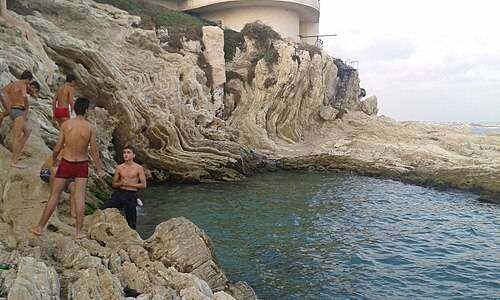
- Has a sea coast
- Population density
- 135 people per km²
Wars and conflicts
- Arab-Israeli wars
- civil war 2011–2024 (over 500,000 killed)
- 2025 sectarian violence
Empires and states that once stood here
Mamluk Sultanate 1250–1517United Arab Republic 1958–1961Islamic State "caliphate" 2014–2019
Alliances and memberships
Political unions and regional organisations
Arab LeagueOrganisation of Islamic Cooperation
Syria in depth
Detailed facts from the CIA World Factbook (public domain, latest edition).
Overview
- History in brief
- After World War I, France acquired a mandate over the northern portion of the former Ottoman Empire province of Syria. The French administered the area until granting it independence in 1946. The new country lacked political stability and experienced a series of military coups. Syria united with Egypt in 1958 to form the United Arab Republic. In 1961, the two entities separated, and the Syrian Arab Republic was reestablished. In the 1967 Arab-Israeli War, Syria lost control of the Golan Heights region to Israel. During the 1990s, Syria and Israel held occasional, albeit unsuccessful, peace talks over its return. In 1970, Hafiz al-ASAD, a member of the socialist Ba'ath Party and the minority Alawi sect, seized power in a bloodless coup and brought political stability to the country. Following the death of al-ASAD, his son, Bashar al-ASAD, was approved as president by popular referendum in 2000. Syrian troops that were stationed in Lebanon since 1976 in an ostensible peacekeeping role were withdrawn in 2005. During the 2006 conflict between Israel and Hizballah, Syria placed its military forces on alert but did not intervene directly on behalf of its ally Hizballah. In 2007, Bashar al-ASAD's second term as president was again approved in a referendum. In the wake of major uprisings elsewhere in the region, antigovernment protests broke out in the southern province of Dar'a in 2011. Protesters called for the legalization of political parties, the removal of corrupt local officials, and the repeal of the restrictive Emergency Law allowing arrests without charge. Demonstrations and violent unrest spread across Syria, and the government responded with concessions, but also with military force and detentions that led to extended clashes and eventually civil war. International pressure on the Syrian Government intensified after 2011, as the Arab League, the EU, Turkey, and the US expanded economic sanctions against the ASAD regime and those entities that supported it. In 2012, more than 130 countries recognized the Syrian National Coalition as the sole legitimate representative of the Syrian people. In 2015, Russia launched a military intervention on behalf of the ASAD regime, and domestic and foreign-government-aligned forces recaptured swaths of territory from opposition forces. With foreign support, the regime continued to periodically regain opposition-held territory until 2020, when Turkish firepower halted a regime advance and forced a stalemate between regi
Geography
- Location
- Middle East, bordering the Mediterranean Sea, between Lebanon and Turkey
- Size compared
- slightly more than 1.5 times the size of Pennsylvania
- Land borders
- Total: 2,363 kmBorder countries: Iraq 599 km; Israel 83 km; Jordan 379 km; Lebanon 403 km; Turkey 899 km
- Coastline
- 193 km
- Climate
- mostly desert; hot, dry, sunny summers (June to August) and mild, rainy winters (December to February) along coast; cold weather with snow or sleet periodically in Damascus
- Terrain
- primarily semiarid and desert plateau; narrow coastal plain; mountains in west
- Elevation
- Highest point: Mount Hermon (Jabal a-Shayk) 2,814 mLowest point: Yarmuk River -66 mMean elevation: 514 m
- Natural resources
- petroleum, phosphates, chrome and manganese ores, asphalt, iron ore, rock salt, marble, gypsum, hydropower
- Major rivers
- Euphrates (shared with Turkey [s], Iran, and Iraq [m]) - 3,596 km; Tigris (shared with Turkey, Iran, and Iraq [m]) - 1,950 kmNote: [s] after country name indicates river source; [m] after country name indicates river mouth
- Natural hazards
- dust storms, sandstormsVolcanism: Syria's two historically active volcanoes, Es Safa and an unnamed volcano near the Turkish border, have not erupted in centuries
- Notes
- the capital of Damascus is located at an oasis fed by the Barada River and is thought to be one of the world's oldest continuously inhabited cities; there are Israeli settlements and civilian land-use sites in the Israeli-controlled Golan Heights (2017)
- Environmental issues
- deforestation; overgrazing; soil erosion; desertification; depletion of water resources; water pollution from raw sewage and petroleum refining wastes; inadequate potable water
People and society
- Population
- Total: 24,261,882 (2025 est.)Male: 12,183,128Female: 12,078,754
- Nationality
- Noun: Syrian(s)Adjective: Syrian
- Ethnic groups
- Arab ~50%, Alawite ~15%, Kurd ~10%, Levantine ~10%, other ~15% (includes Druze, Ismaili, Imami, Nusairi, Assyrian, Turkoman, Armenian)
- Languages
- Arabic (official), Kurdish, Armenian, Aramaic, Circassian, French, EnglishMajor-language sample(s): كتاب حقائق العالم، المصدر الذي لا يمكن الاستغناء عنه للمعلومات الأساسية (Arabic)ڕاستییەکانی جیهان، باشترین سەرچاوەیە بۆ زانیارییە بنەڕەتییەکان (Kurdish)The World Factbook, the indispensable source for basic information.
- Religions
- Muslim 87% (official; includes Sunni 74% and Alawi, Ismaili, and Shia 13%), Christian 10% (includes Orthodox, Uniate, and Nestorian), Druze 3%
- Median age
- Total: 24.5 years (2025 est.)Male: 23.6 yearsFemale: 24.7 years
- Population growth
- 1.63% (2025 est.)
- Life expectancy
- Total population: 74.8 years (2024 est.)Male: 73.4 yearsFemale: 76.4 years
- Children per woman
- 2.64 children born/woman (2025 est.)
- Urbanization
- Urban population: 57.4% of total population (2023)Rate of urbanization: 5.38% annual rate of change (2020-25 est.)
- Largest cities
- 2.585 million DAMASCUS (capital), 2.203 million Aleppo, 1.443 million Hims (Homs), 996,000 Hamah (2023)
- Literacy
- Total population: 94.4% (2021 est.)Male: 97.2% (2021 est.)Female: 91.8% (2021 est.)
Government
- Official names
- Conventional long form: Syrian Arab RepublicConventional short form: SyriaLocal long form: Al Jumhuriyah al Arabiyah as SuriyahLocal short form: SuriyahFormer: United Arab Republic (with Egypt)Etymology: the source of the name is uncertain; the name appears as "Suri" in Babylonian cuneiform writings dating from about 4000 B.C.
- Government type
- transitional presidential republic
- Capital
- Name: DamascusGeographic coordinates: 33 30 N, 36 18 ETime difference: UTC+3 (8 hours ahead of Washington, DC, during Standard Time)Etymology: the city has an ancient, pre-Semitic name of unknown origin
- Regions
- 14 provinces (muhafazat, singular - muhafazah); Al Hasakah, Al Ladhiqiyah (Latakia), Al Qunaytirah, Ar Raqqah, As Suwayda', Dar'a, Dayr az Zawr, Dimashq (Damascus), Halab (Aleppo), Hamah, Hims (Homs), Idlib, Rif Dimashq (Damascus Countryside), Tartus
- Independence
- 17 April 1946 (from League of Nations mandate under French administration)
- National holiday
- Independence Day (Evacuation Day), 17 April (1946)
- Constitution
- History: Syria's 2012 constitution was rescinded by the Hayat Tahrir al-Sham-led government in January 2025; in March 2025, interim authorities announced a transitional constitution to remain in effect for up to five years
- Legal system
- mixed system of civil and Islamic (sharia) law (for family courts)
- Voting age
- 18 years of age; universal
- Flag meaning
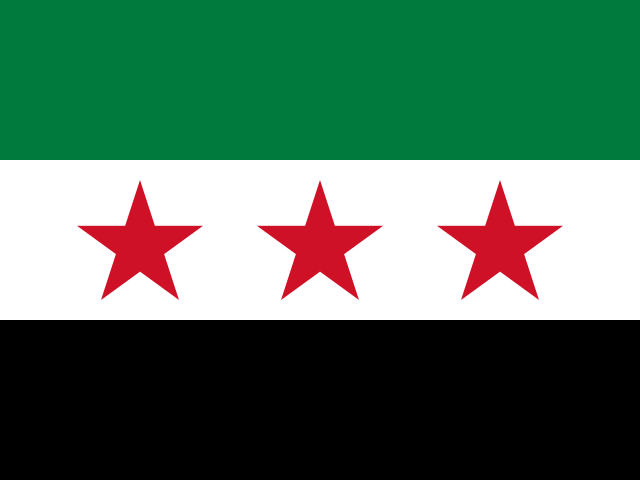
- Description: three equal horizontal bands of green (top), white, and black; three five-pointed red stars in a horizontal line, centered on the white bandMeaning: the design is the same as a previous Syrian national flag (in use 1932-58 and 1961-63), but it is still unclear if the elements will retain the same meanings; the bands formerly represented Syria’s past rulers: white (Umayyad Caliphate), black (Abbasid Caliphate), and green (Rashidun Caliphate); the first star represented Damascus, Aleppo, and Deir ez-Zor, the three administrative subdivisions in Syria in the 1930s; the second star stood for Jabal Druze (the Mountain of the Druze), and the third star for the Alawite MountainsHistory: in 2011, opponents to the Asad regime adopted the flag; in 2025, it became the new national flag, replacing the two-star design
- National symbols
- northern bald ibis
- National colours
- red, white, black, green
- National anthem
- Title: “Ħumāt ad-Diyār (Guardians of the Homeland)Lyrics/music: Khalil Mardam BEY/Mohammad Salim FLAYFEL and Ahmad Salim FLAYFELHistory: adopted 1936, restored 1961; the country had a different anthem between 1958 and 1961, when Syria was part of the United Arab Republic
- UNESCO World Heritage Sites
- Total World Heritage Sites: 6 (all cultural)Selected World Heritage Site locales: Ancient City of Damascus; Ancient City of Bosra; Site of Palmyra; Ancient City of Aleppo; Crac des Chevaliers and Qal’at Salah El-Din; Ancient Villages of Northern Syria
Economy
- Overview
- low-income Middle Eastern economy; prior infrastructure and economy devastated by 11-year civil war; ongoing US sanctions; sporadic trans-migration during conflict; currently being supported by World Bank trust fund; ongoing hyperinflation
- GDP (PPP)
- $98.858 billion (2023 est.)
- GDP per person (PPP)
- $4,200 (2023 est.)
- GDP growth
- -1.2% (2023 est.)
- Inflation
- 94.1% (2022 est.)
- Unemployment
- 13% (2024 est.)
- Farm products
- wheat, barley, milk, sheep milk, tomatoes, olives, potatoes, maize, oranges, grapes (2023)
- Industries
- petroleum, textiles, food processing, beverages, tobacco, phosphate rock mining, cement, oil seeds crushing, automobile assembly
- Exports
- $1.609 billion (2022 est.)
- Main exports
- olive oil, phosphates, spice seeds, cotton, tomatoes (2023)
- Export partners
- Turkey 29%, Saudi Arabia 16%, Lebanon 10%, India 10%, UAE 5% (2023)
- Main imports
- tobacco, plastics, wheat flours, plastic products, seed oils (2023)
- Import partners
- Turkey 49%, UAE 11%, China 8%, Egypt 7%, Lebanon 3% (2023)
- Money sent home from abroad
- 0% of GDP (2023 est.)
Energy, internet and transport
- Electricity access
- Electrification - total population: 89% (2022 est.)Electrification - urban areas: 100%Electrification - rural areas: 75%
- Electricity sources
- Fossil fuels: 95.6% of total installed capacity (2023 est.)Solar: 0.5% of total installed capacity (2023 est.)Hydroelectricity: 3.8% of total installed capacity (2023 est.)Biomass and waste: 0.2% of total installed capacity (2023 est.)
- Internet users
- Percent of population: 35% (2019 est.)
- Mobile phones
- Total subscriptions: 17.6 million (2024 est.)Subscriptions per 100 inhabitants: 71 (2024 est.)
- TV and radio
- state-run TV has 2 networks and 5 satellite channels; roughly two-thirds of homes have a satellite dish with access to foreign TV; 3 state-run radio channels; first private radio station launched in 2005; private radio broadcasters prohibited from transmitting news or political content (2018)
- Airports
- 42 (2025)
- Railways
- Total: 2,052 km (2014)Standard gauge: 1,801 km (2014) 1.435-m gaugeNarrow gauge: 251 km (2014) 1.050-m gauge
- Merchant ships
- Total: 24 (2023)By type: bulk carrier 1, container ship 1, general cargo 8, oil tanker 1, other 13
Military and space
- Armed forces
- the interim government authorities in Syria have established a Ministry of Defense and are attempting to unify the dozens of armed factions operating in Syria under a single, state-linked army; it has also established a Ministry of Interior to manage police and other security forces (2025)
- Military spending
- 6.5% of GDP (2019 est.)
- Military service
- under Bashar al-ASAD, Syrian men aged 18-38 were required to serve 18-21 months in the military; conscription continued until ASAD's fall when the interim government announced that mandatory conscription to Syria’s armed forces would be abolished and only be reinstated in extreme cases, such as national emergencies relating to war (2025)
- Space programme
- status unclear; has been handicapped by the impact of the civil war, including the loss of students and scientists who fled the country; had previously focused on satellite development and related space technologies, as well as scientific research; has relations with the space agency and space industries of Russia (2024)
- Space milestones
- 1987 - first and only Syrian astronaut into space as part of a Soviet-crewed mission to the Mir Space Station under the Intercosmos program2016 - signed a scientific cooperation agreement in the field of space technology and remote sensing with Russia2018 - announced that developing a satellite would be a primary goal of the space program
Global issues
- Refugees and displaced people
- Refugees: 16,402 (2024 est.)IDPs: 7,408,809 (2024 est.)Stateless persons: 160,000 (2024 est.)
Neighbouring countries
IraqIsraelJordanLebanonTürkiye
- Phone code
- +963
- Internet domain
- .sy