Kazakhstan
Republic of Kazakhstan · Қазақстан · Казахстан
Nomadic steppe of the Kazakh Khanate, founded 1465 by Kerei and Janibek. Absorbed by Russia in the 18th–19th centuries; Soviet collectivisation killed over a third of Kazakhs. Largest landlocked country; hosts the Baikonur Cosmodrome.
See Kazakhstan on the 3D globeTake a quiz
Did you know?
- Wild apples, ancestors of all modern apples, come from here
- All human spaceflights from Gagarin to today's Soyuz launch from Baikonur
- Largest landlocked country in the world
Key facts about Kazakhstan
- Government
- Presidential republic
- Religion
- Islam ~70%, Russian Orthodox ~17%
- Founded / independence
- 1991 (from USSR); Kazakh Khanate 1465
- Rich in
- Oil, uranium (world's largest producer), coal, wheat
- Languages
- Kazakh, Russian
Kazakh and Russian; moving Kazakh to Latin script - Currency
- Kazakhstani tenge (₸)
- People are called
- Kazakhstani
- Main cities
- Almaty, Astana, Shymkent, Karaganda, Aktobe
Timeline of Kazakhstan
- 1465Kazakh Khanate
- 1731Junior Jüz accepts Russian protection
- 1930Famine
- 1949Soviet nuclear tests begin at Semipalatinsk
- 1991Independence
- 1997Capital moves to Astana
- 2022January unrest
Places to see in Kazakhstan
- Bayterek Tower, Astana
- Charyn Canyon
- Big Almaty Lake
- Mausoleum of Khoja Ahmed Yasawi, Turkistan
- Baikonur Cosmodrome
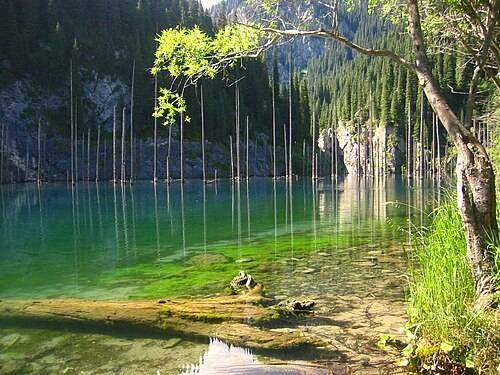
- Kolsai Lakes
Food and drink
Beshbarmak · kazy (horse sausage) · kumis (fermented mare's milk) · baursak
Culture and famous for
Nomadic yurts; dombra music; eagle hunting; apples (originated near Almaty)
Popular sports
Boxing, wrestling, ice hockey, kokpar
Geography and climate
- Highest point
- Khan Tengri, about 7,010 m
- Rivers, lakes and seas
- Irtysh, Syr Darya, Ural; Caspian Sea, Lake Balkhash
- Climate
- Extreme continental
- Coastline
- Landlocked
- Population density
- 8 people per km²
Wars and conflicts
- Dzungar wars
- 1916 revolt
- famine 1930–33
- January 2022 unrest
Empires and states that once stood here
Scythia c. 700–200 BCGöktürk Khaganate 552–744Khazar Khaganate c. 650–969Kazakh Khanate 1465–1847Soviet Union (USSR) 1922–1991
Alliances and memberships
Military and security
CSTOShanghai Cooperation Organisation
Political unions and regional organisations
Eurasian Economic UnionCommonwealth of Independent StatesOrganization of Turkic StatesBRICS (partner country)Organisation of Islamic Cooperation
Economy and trade
OPEC (OPEC+ partner (not a member))
Kazakhstan in depth
Detailed facts from the CIA World Factbook (public domain, latest edition).
Overview
- History in brief
- Ethnic Kazakhs derive from a mix of Turkic nomadic tribes that migrated to the region in the 15th century. The Russian Empire conquered the Kazakh steppe in the 18th and 19th centuries, and Kazakhstan became a Soviet Republic in 1925. Forced agricultural collectivization led to repression and starvation, resulting in more than a million deaths in the early 1930s. During the 1950s and 1960s, the agricultural "Virgin Lands" program generated an influx of settlers -- mostly ethnic Russians, but also other nationalities -- and by the time of Kazakhstan’s independence in 1991, ethnic Kazakhs were a minority. However, non-Muslim ethnic minorities departed Kazakhstan in large numbers from the mid-1990s through the mid-2000s, and a national program has repatriated about a million ethnic Kazakhs (from Uzbekistan, Tajikistan, Mongolia, and the Xinjiang region of China) to Kazakhstan. As a result of this shift, the ethnic Kazakh share of the population now exceeds two-thirds.Kazakhstan's economy is the largest in Central Asia, mainly due to the country's vast natural resources. Current issues include diversifying the economy, attracting foreign direct investment, enhancing Kazakhstan's economic competitiveness, and strengthening economic relations with neighboring states and foreign powers.
Geography
- Location
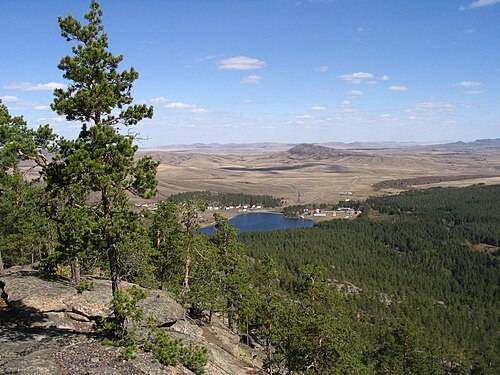
- Central Asia, northwest of China; a small portion west of the Ural (Oral) River in easternmost Europe
- Size compared
- slightly less than four times the size of Texas
- Land borders
- Total: 13,364 kmBorder countries: China 1,765 km; Kyrgyzstan 1,212 km; Russia 7,644 km; Turkmenistan 413 km; Uzbekistan 2,330 km
- Coastline
- 0 km (landlocked)
- Climate
- continental, cold winters and hot summers, arid and semiarid
- Terrain
- vast flat steppe extending from the Volga in the west to the Altai Mountains in the east and from the plains of western Siberia in the north to oases and deserts of Central Asia in the south
- Elevation
- Highest point: Pik Khan-Tengri 7,010 mnote - the northern most 7,000 meter peak in the WorldLowest point: Qauyndy Oyysy -132 mMean elevation: 387 m
- Natural resources
- major deposits of petroleum, natural gas, coal, iron ore, manganese, chrome ore, nickel, cobalt, copper, molybdenum, lead, zinc, bauxite, gold, uranium
- Major rivers
- Syr Darya river mouth (shared with Kyrgyzstan [s], Uzbekistan, and Tajikistan) - 3,078 kmNote: [s] after country name indicates river source; [m] after country name indicates river mouth
- Major lakes
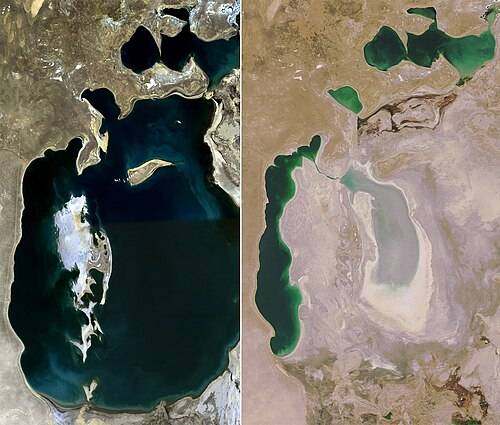
- Fresh water lake(s): Ozero Balkhash - 22,000 sq km; Ozero Zaysan - 1,800 sq kmSalt water lake(s): Caspian Sea (shared with Iran, Azerbaijan, Turkmenistan, and Russia) - 374,000 sq km; Aral Sea (north) - 3,300 sq km; Ozero Alakol - 2,650 sq km; Ozero Teniz 1,590 sq km; Ozero Seletytenzi - 780 sq km; Ozero Sasykkol - 740 sq km
- Natural hazards
- earthquakes in the south; mudslides around Almaty
- Notes
- world's largest landlocked country and one of only two landlocked countries in the world that extends into two continents (the other is Azerbaijan); Russia leases approximately 6,000 sq km (2,317 sq mi) of territory enclosing the Baikonur Cosmodrome
- Environmental issues
- radioactive or toxic chemical sites from former defense industries; severe industrial pollution in some cities; air and soil pollution (including dust storms) from chemical pesticides and natural salts left after two rivers were diverted; soil pollution from overuse of agricultural chemicals; salination from infrastructure and irrigation practices; water pollution; desertification
People and society
- Population
- Total: 20,432,662 (2025 est.)Male: 9,902,303Female: 10,530,359
- Nationality
- Noun: Kazakhstani(s)Adjective: Kazakhstani
- Ethnic groups
- Kazakh 71%, Russian 14.9%, Uzbek 3.3%, Ukrainian 1.9%, Uyghurs 1.5%, German 1.1%, Tatar 1.1%, other 4.9%, unspecified 0.3% (2023 est.)
- Languages
- Kazakh (official, Qazaq) 80.1%, Russian 83.7%, English 35.1% (2021 est.)Major-language sample(s): Әлемдік деректер кітабы, негізгі ақпараттың таптырмайтын көзі. (Kazakh)Книга фактов о мире – незаменимый источник базовой информации. (Russian)The World Factbook, the indispensable source for basic information.
- Religions
- Muslim 69.3%, Christian 17.2% (Orthodox 17%, other 0.2%), Buddhism 0.1%, other 0.1%, non-believers 2.3%, unspecified 11% (2021 est.)
- Median age
- Total: 32.1 years (2025 est.)Male: 30 yearsFemale: 33.8 years
- Population growth
- 0.83% (2025 est.)
- Life expectancy
- Total population: 73.3 years (2024 est.)Male: 69 yearsFemale: 77.9 years
- Children per woman
- 2.57 children born/woman (2025 est.)
- Urbanization
- Urban population: 58.2% of total population (2023)Rate of urbanization: 1.19% annual rate of change (2020-25 est.)
- Largest cities
- 1.987 million Almaty, 1.291 million NUR-SULTAN (capital), 1.155 million Shimkent (2023)
- Years in school
- Total: 14 years (2024 est.)Male: 14 years (2024 est.)Female: 14 years (2024 est.)
Government
- Official names
- Conventional long form: Republic of KazakhstanConventional short form: KazakhstanLocal long form: Qazaqstan RespublikasyLocal short form: QazaqstanFormer: Kazakh Soviet Socialist RepublicEtymology: the name may derive from the Turkic word kazak, meaning "nomad;" the Persian suffix -stan means "place of" or "country"
- Government type
- presidential republic
- Capital
- Name: AstanaGeographic coordinates: 51 10 N, 71 25 ETime difference: UTC+5 (10 hours ahead of Washington, DC, during Standard Time)Time zone note: On 1 March 2024, Kazakhstan moved from using two time zones to oneEtymology: the name means "capital city" in Kazakh
- Regions
- 17 provinces (oblystar, singular - oblys) and 4 cities* (qalalar, singular - qala); Abay (Semey), Almaty (Qonaev), Almaty*, Aqmola (Kokshetau), Aqtobe, Astana*, Atyrau, Batys Qazaqstan [West Kazakhstan] (Oral), Bayqongyr*, Mangghystau (Aqtau), Pavlodar, Qaraghandy, Qostanay, Qyzylorda, Shyghys Qazaqstan [East Kazakhstan] (Oskemen), Shymkent*, Soltustik Qazaqstan [North Kazakhstan] (Petropavl), Turkistan, Ulytau (Zhezqazghan), Zhambyl (Taraz), Zhetisu (Taldyqorghan)
- Independence
- 16 December 1991 (from the Soviet Union)
- National holiday
- Independence Day, 16 December (1991)
- Constitution
- History: previous 1937, 1978 (pre-independence), 1993; latest approved by referendum 30 August 1995, effective 5 September 1995Amendment process: introduced by a referendum initiated by the president of the republic, on the recommendation of Parliament, or by the government; the president has the option of submitting draft amendments to Parliament or directly to a referendum; passage of amendments by Parliament requires four-fifths majority vote of both houses and the signature of the president; passage by referendum requires absolute majority vote by more than one half of the voters in at least two thirds of the oblasts, major cities, and the capital, followed by the signature of the president
- Legal system
- civil law system influenced by Roman-Germanic law and by the theory and practice of the Russian Federation
- Voting age
- 18 years of age; universal
- Flag meaning
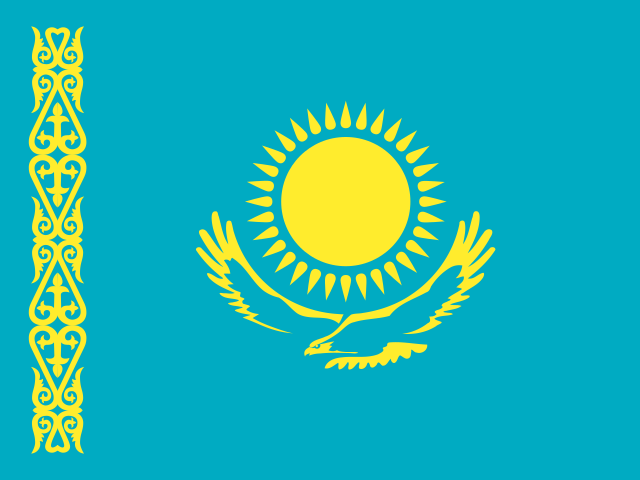
- Description: a gold sun with 32 rays above a soaring golden steppe eagle, both centered on a sky-blue background; the left side displays a national pattern called koshkar-muiz (the horns of the ram) in goldMeaning: the blue color has religious significance for the Turkic peoples and symbolizes cultural and ethnic unity, as well as sky and water; the sun stands for wealth and plenitude, with rays shaped like grain; the eagle has appeared on Kazakh tribal flags for centuries and represents freedom, power, and the flight to the future
- National symbols
- golden eagle
- National colours
- blue, yellow
- National anthem
- Title: "Menin Qazaqstanim" (My Kazakhstan)Lyrics/music: Zhumeken NAZHIMEDENOV and Nursultan NAZARBAYEV/Shamshi KALDAYAKOVHistory: adopted 2006; President Nursultan NAZARBAYEV played a role in revising the lyrics
- UNESCO World Heritage Sites
- Total World Heritage Sites: 6 (3 cultural, 3 natural)Selected World Heritage Site locales: Mausoleum of Khoja Ahmed Yasawi (c); Petroglyphs at Tanbaly (c); Saryarka - Steppe and Lakes of Northern Kazakhstan (n); Silk Roads: the Chang'an-Tianshan Corridor (c); Western Tien-Shan (n); Cold Winter Deserts of Turan (n)
Economy
- Overview
- upper-middle-income Central Asian economy; robust growth due to rising oil production, expansion in manufacturing and services, rising domestic demand, and infrastructure investments; however, rapid growth contributing to high inflation rate; declining unemployment and poverty rates
- GDP (PPP)
- $739.385 billion (2024 est.)
- GDP per person (PPP)
- $35,900 (2024 est.)
- GDP growth
- 4.8% (2024 est.)
- Inflation
- 8.8% (2024 est.)
- Unemployment
- 4.8% (2024 est.)
- Below poverty line
- 5.2% (2023 est.)
- Farm products
- wheat, milk, barley, potatoes, watermelons, cantaloupes/melons, sunflower seeds, maize, onions, tomatoes (2023)
- Industries
- oil, coal, iron ore, manganese, chromite, lead, zinc, copper, titanium, bauxite, gold, silver, phosphates, sulfur, uranium, iron and steel; tractors and other agricultural machinery, electric motors, construction materials
- Exports
- $91.908 billion (2024 est.)
- Main exports
- crude petroleum, gold, radioactive chemicals, refined copper, copper ore (2023)
- Export partners
- China 16%, UK 15%, Russia 10%, Turkey 6%, Italy 5% (2023)
- Main imports
- garments, cars, broadcasting equipment, vehicle bodies, packaged medicine (2023)
- Import partners
- China 28%, Russia 24%, Gambia, The 4%, Turkey 4%, USA 4% (2023)
- Money sent home from abroad
- 0.1% of GDP (2024 est.)
Energy, internet and transport
- Electricity access
- Electrification - total population: 100% (2022 est.)
- Electricity sources
- Fossil fuels: 87.7% of total installed capacity (2023 est.)Solar: 1.9% of total installed capacity (2023 est.)Wind: 2.1% of total installed capacity (2023 est.)Hydroelectricity: 8.2% of total installed capacity (2023 est.)
- Internet users
- Percent of population: 93% (2023 est.)
- Mobile phones
- Total subscriptions: 26.2 million (2024 est.)Subscriptions per 100 inhabitants: 127 (2024 est.)
- TV and radio
- the state owns nearly all radio and TV transmission facilities and operates national TV and radio networks; there are 96 TV channels, and 4 state-run radio stations; some former state-owned media outlets have been privatized; households with satellite dishes have access to foreign media; small number of commercial radio stations; all media outlets have to register with the government (2018)
- Airports
- 132 (2025)
- Railways
- Total: 16,636 km (2021)Broad gauge: 16,636 km (2021) 1.520-m gauge (4,237 km electrified)
- Merchant ships
- Total: 122 (2023)By type: general cargo 3, oil tanker 7, other 112
Military and space
- Armed forces
- Armed Forces of the Republic of Kazakhstan: Land Forces (Army of Kazakhstan), Naval Forces, Air and Air Defense ForcesMinistry of Internal Affairs: National Police, National GuardCommittee for National Security (KNB): Border Guard Service (2025)
- Military spending
- 0.9% of GDP (2024 est.)
- Military service
- men 18-27 are subject to conscription for 12-24 months; conscripts may be assigned to the Armed Forces, the National Guard, the Border Service, the State Security Service, or the Ministry of Emergency Situations; women may volunteer (2025)
- Space programme
- space program originated with the former Soviet Union; focuses on satellite acquisition and operation; builds (with foreign assistance) and operates communications, remote sensing (RS), and scientific satellites; building space infrastructure, such as launch and testing facilities, ground stations, and rocket manufacturing; has an astronaut (cosmonaut) program; has relations with a variety of foreign space agencies and industries, including those of China, France, Germany, India, Israel, Italy, Japan, Russia, Saudi Arabia, Sweden, Thailand, Turkey, Ukraine, UAE, and the UK; participates in international programs such as the International Space Station; has state-owned and private companies that assist with the country’s space program and work closely with foreign commercial entities (2025)
- Space milestones
- 1991 - first Kazakh in space on the last Soviet Soyuz mission2006 - first communications satellite (KazSat-1) built jointly with Italy and launched by Russia2014 - first remote sensing satellite (KazEOSat-1) built by France and launched on European rocket2024 - joined China-led lunar base project
Global issues
- Refugees and displaced people
- Refugees: 66,152 (2024 est.)IDPs: 0 (2024 est.)Stateless persons: 7,865 (2024 est.)
Neighbouring countries
ChinaKyrgyzstanRussiaTurkmenistanUzbekistan
- Phone code
- +7
- Internet domain
- .kz