Uzbekistan
Republic of Uzbekistan · Узбекистан · O‘zbekiston
Samarkand and Bukhara were Silk Road jewels; Timur ruled from here in the 14th century. Conquered by Russia in the 19th century; opening up since 2016.
See Uzbekistan on the 3D globeTake a quiz
Population37 million
Area447,400 km²
CapitalTashkent
RegionCentral Asia
Did you know?
- One of two doubly landlocked countries
- The Aral Sea shrank by about 90% due to irrigation
- Samarkand is about 2,750 years old
Key facts about Uzbekistan
- Government
- Presidential republic
- Religion
- Sunni Islam ~90%
- Founded / independence
- 1991 (from USSR)
- Rich in
- Gold, cotton, natural gas, uranium, Silk Road tourism
- Languages
- Russian, Uzbek
Uzbek (Latin script); Russian, Tajik, Karakalpak - Currency
- Uzbekistani soʻm (so'm)
- People are called
- Uzbekistani
- Main cities
- Tashkent, Samarkand, Namangan, Andijan, Bukhara
Timeline of Uzbekistan
- 1370Timur's empire
- 1500sKhanates of Bukhara, Khiva, Kokand
- 1865Russia takes Tashkent
- 1924Soviet republic
- 1991Independence
- 2016Reforms begin
Places to see in Uzbekistan
- Registan, Samarkand
- Bukhara old city
- Khiva's Itchan Kala
- Shah-i-Zinda
- Tashkent metro
Food and drink
Plov (UNESCO) · samsa · lagman · non bread
Culture and famous for
Silk Road cities; ikat silk; ceramics; astronomer Ulugh Beg
Popular sports
Wrestling, boxing, football, chess
Geography and climate
- Highest point
- Khazret Sultan, 4,643 m
- Rivers, lakes and seas
- Amu Darya, Syr Darya; shrinking Aral Sea
- Climate
- Continental desert
- Coastline
- Landlocked
- Population density
- 83 people per km²
Wars and conflicts
- Mongol conquest
- Timur's wars
- Russian conquest
Empires and states that once stood here
Khwarazmian Empire 1077–1231Soviet Union (USSR) 1922–1991
Alliances and memberships
Military and security
Shanghai Cooperation Organisation
Political unions and regional organisations
Eurasian Economic Union (observer)Commonwealth of Independent StatesOrganization of Turkic StatesBRICS (partner country)Organisation of Islamic Cooperation
Uzbekistan in depth
Detailed facts from the CIA World Factbook (public domain, latest edition).
Overview
- History in brief
- Uzbekistan is the geographic and population center of Central Asia, with a diverse economy and a relatively young population. Russia conquered and united the disparate territories of present-day Uzbekistan in the late 19th century. Stiff resistance to the Red Army after the Bolshevik Revolution was eventually suppressed and a socialist republic established in 1924. During the Soviet era, intensive production of "white gold" (cotton) and grain led to the overuse of agrochemicals and the depletion of water supplies, leaving the land degraded and the Aral Sea and certain rivers half-dry. Independent since the Union of Soviet Socialist Republics (USSR) dissolved in 1991, the country has diversified agricultural production while developing its mineral and petroleum export capacity and increasing its manufacturing base, although cotton remains a major part of its economy. Uzbekistan’s first president, Islom KARIMOV, led Uzbekistan for 25 years until his death in 2016. His successor, former Prime Minister Shavkat MIRZIYOYEV, has improved relations with Uzbekistan’s neighbors and introduced wide-ranging economic, judicial, and social reforms. MIRZIYOYEV was reelected in 2021 with 80% of the vote and again following a 2023 constitutional referendum with 87% of the vote.
Geography
- Location
- Central Asia, north of Turkmenistan, south of Kazakhstan
- Size compared
- about four times the size of Virginia; slightly larger than California
- Land borders
- Total: 6,893 kmBorder countries: Afghanistan 144 km; Kazakhstan 2,330 km; Kyrgyzstan 1,314 km; Tajikistan 1,312 km; Turkmenistan 1,793 km
- Coastline
- 0 km (doubly landlocked)
- Climate
- mostly mid-latitude desert, long, hot summers, mild winters; semiarid grassland in east
- Terrain
- mostly flat-to-rolling sandy desert with dunes; broad, flat intensely irrigated river valleys along course of Amu Darya, Syr Darya (Sirdaryo), and Zaravshan; Fergana Valley in east surrounded by mountainous Tajikistan and Kyrgyzstan; shrinking Aral Sea in west
- Elevation
- Highest point: Xazrat Sulton Tog' 4,643 mLowest point: Sariqamish Kuli -12 m
- Natural resources
- natural gas, petroleum, coal, gold, uranium, silver, copper, lead and zinc, tungsten, molybdenum
- Major rivers
- Syr Darya (shared with Kyrgyzstan [s], Tajikistan, and Kazakhstan [m]) - 3,078 km; Amu Darya river mouth (shared with Tajikistan [s], Afghanistan, and Turkmenistan) - 2,620 kmNote: [s] after country name indicates river source; [m] after country name indicates river mouth
- Major lakes
- Fresh water lake(s): Aral Sea (shared with Kazakhstan) - largely dried up
- Natural hazards
- earthquakes; floods; landslides or mudslides; avalanches; droughts
- Notes
- along with Liechtenstein, one of the only two doubly landlocked countries in the world
- Environmental issues
- growing concentrations of chemical pesticides and natural salts in the shrinking Aral Sea; desertification; water pollution and soil salination from industrial wastes and the heavy use of fertilizers and pesticides; soil contamination from buried nuclear processing and agricultural chemicals
People and society
- Population
- Total: 37,015,151 (2025 est.)Male: 18,576,048Female: 18,439,103
- Nationality
- Noun: UzbekistaniAdjective: Uzbekistani
- Ethnic groups
- Uzbek 83.8%, Tajik 4.8%, Kazakh 2.5%, Russian 2.3%, Karakalpak 2.2%, Tatar 1.5%, other 2.9% (2017 est.)
- Languages
- Uzbek (official) 74.3%, Russian 14.2%, Tajik 4.4%, other 7.1%Major-language sample(s): Jahon faktlari kitobi, asosiy ma'lumotlar uchun zaruriy manba. (Uzbek)The World Factbook, the indispensable source for basic information.
- Religions
- Muslim 88% (mostly Sunni), Eastern Orthodox 9%, other 3%
- Median age
- Total: 29.2 years (2025 est.)Male: 28.1 yearsFemale: 29.8 years
- Population growth
- 1.26% (2025 est.)
- Life expectancy
- Total population: 76.2 years (2024 est.)Male: 73.6 yearsFemale: 79 years
- Children per woman
- 2.6 children born/woman (2025 est.)
- Urbanization
- Urban population: 50.5% of total population (2023)Rate of urbanization: 1.25% annual rate of change (2020-25 est.)
- Largest cities
- 2.603 million TASHKENT (capital) (2023)
- Literacy
- Total population: 100% (2022 est.)Male: 100% (2022 est.)Female: 100% (2022 est.)
- Years in school
- Total: 13 years (2024 est.)Male: 13 years (2024 est.)Female: 13 years (2024 est.)
Government
- Official names
- Conventional long form: Republic of UzbekistanConventional short form: UzbekistanLocal long form: O'zbekiston RespublikasiLocal short form: O'zbekistonFormer: Uzbek Soviet Socialist RepublicEtymology: the name comes from the local people, the Uzbeks, whose name is said to have originated with Mongol leader Ghiyath ad-Din Muhammad UZBEK; the Persian suffix -stan means "country"
- Government type
- presidential republic; highly authoritarian
- Capital
- Name: Tashkent (Toshkent)Geographic coordinates: 41 19 N, 69 15 ETime difference: UTC+5 (10 hours ahead of Washington, DC, during Standard Time)Etymology: the current name of the ancient city was first used in the 11th century and comes from the Sogdian (Turkic) words tash (stone) and kent (town); the city was first recorded in the 5th or 4th century B.C. with the name of Chach or Shash
- Regions
- 12 provinces (viloyatlar, singular - viloyat), 1 autonomous republic* (avtonom respublikasi), and 3 cities** (shahar); Andijon Viloyati, Buxoro Viloyati [Bukhara Province], Farg'ona Viloyati [Fergana Province], Jizzax Viloyati, Namangan Shahri, Namangan Viloyati, Navoiy Viloyati, Qashqadaryo Viloyati (Qarshi), Qoraqalpog'iston Respublikasi [Karakalpakstan Republic]* (Nukus), Samarqand Shahri [Samarkand City], Samarqand Viloyati [Samarkand Province], Sirdaryo Viloyati (Guliston), Surxondaryo Viloyati (Termiz), Toshkent Shahri [Tashkent City]**, Toshkent Viloyati [Nurafshon], Xorazm Viloyati (Urganch)
- Independence
- 1 September 1991 (from the Soviet Union)
- National holiday
- Independence Day, 1 September (1991)
- Constitution
- History: several previous; latest adopted 8 December 1992Amendment process: proposed by the Supreme Assembly or by referendum; passage requires two-thirds majority vote of both houses of the Assembly or passage in a referendum
- Legal system
- civil law system
- Voting age
- 18 years of age; universal
- Flag meaning
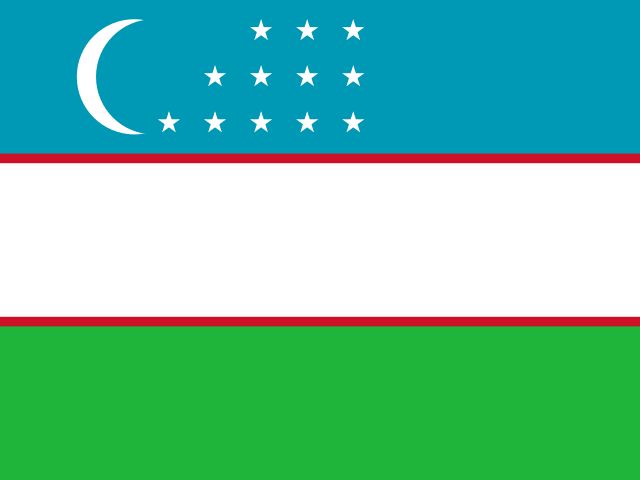
- Description: three equal horizontal bands of blue (top), white, and green separated by narrow red stripes with a vertical white crescent moon and 12 five-pointed white stars in the left corner of the top bandMeaning: blue stands for the Turkic peoples and the sky, white for peace and the striving for purity in thoughts and deeds, and green for nature and Islam; the red stripes represent the vital force of all living organisms; the crescent stands for Islam, and the 12 stars for the months and constellations of the Uzbek calendar
- National symbols
- khumo (mythical bird)
- National colours
- blue, white, red, green
- National anthem
- Title: "O'zbekiston Respublikasining Davlat Madhiyasi" (National Anthem of the Republic of Uzbekistan)Lyrics/music: Abdulla ARIPOV/Mutal BURHANOVHistory: adopted 1992; after the fall of the Soviet Union, Uzbekistan kept the music of its Soviet-era anthem but adopted new lyrics
- UNESCO World Heritage Sites
- Total World Heritage Sites: 7 (5 cultural, 2 natural)Selected World Heritage Site locales: Itchan Kala (c); Historic Bukhara (c); Historic Shakhrisyabz (c); Samarkand - Crossroad of Cultures (c); Western Tien Shan (n); Cold Winter Deserts of Turan (n); Silk Roads: Zarafshan-Karakum Corridor (c)
Economy
- Overview
- lower-middle income Central Asian economy; key exporter of natural gas, cotton, and gold; ongoing reform efforts to reduce state-owned sector dominance, attract foreign investment, and improve sustainability of cotton production
- GDP (PPP)
- $379.989 billion (2024 est.)
- GDP per person (PPP)
- $10,500 (2024 est.)
- GDP growth
- 6.5% (2024 est.)
- Inflation
- 9.6% (2024 est.)
- Unemployment
- 4.5% (2024 est.)
- Below poverty line
- 11% (2023 est.)
- Farm products
- milk, wheat, cotton, potatoes, carrots/turnips, tomatoes, grapes, watermelons, vegetables, apples (2023)
- Industries
- textiles, food processing, machine building, metallurgy, mining, hydrocarbon extraction, chemicals
- Exports
- $26.173 billion (2024 est.)
- Main exports
- gold, cotton yarn, garments, fertilizers, fabric (2023)
- Export partners
- Switzerland 34%, Russia 12%, UK 11%, China 7%, Turkey 6% (2023)
- Main imports
- cars, vehicle parts/accessories, packaged medicine, refined petroleum, aircraft (2023)
- Import partners
- China 32%, Russia 17%, Kazakhstan 8%, S. Korea 6%, Turkey 5% (2023)
- Money sent home from abroad
- 14.4% of GDP (2024 est.)
Energy, internet and transport
- Electricity access
- Electrification - total population: 100% (2022 est.)
- Electricity sources
- Fossil fuels: 90.8% of total installed capacity (2023 est.)Solar: 0.6% of total installed capacity (2023 est.)Hydroelectricity: 8.7% of total installed capacity (2023 est.)
- Internet users
- Percent of population: 89% (2023 est.)
- Mobile phones
- Total subscriptions: 40.2 million (2024 est.)Subscriptions per 100 inhabitants: 1,110 (2024 est.)
- TV and radio
- state-controlled media; 17 state-owned broadcasters, including 13 TV and 4 radio, with national service; about 20 privately owned TV stations, overseen by local officials, broadcast locally; privately owned TV stations required to lease transmitters from state-owned Republic TV and Radio Industry Corporation (2019)
- Airports
- 74 (2025)
- Railways
- Total: 4,642 km (2018)Broad gauge: 4,642 km (2018) 1.520-m gauge (1,684 km electrified)
Military and space
- Armed forces
- Armed Forces of Uzbekistan: Army, Air and Air Defense Forces; National GuardMinistry of Internal Affairs: Internal Security Troops, Border Guards, police (2024)
- Military spending
- 2.8% of GDP (2019 est.)
- Military service
- 18-30 for voluntary/contract service for men and women; 18-27 years of age for compulsory military service for men with a 12-month service obligation (2025)
- Space programme
- has a small but growing space effort focused on acquiring satellites and developing the country’s space industries and technologies in key sectors, including cartography, data processing, environmental and disaster monitoring, land use, resource management, and telecommunications; recognized for its astronomy program; member of international space organizations; cooperates with foreign space agencies or commercial companies from a variety of countries, including those of Canada, China, France, India, Israel, Japan, Kazakhstan, Russia, South Korea, Spain, Turkey, and the UAE (2025)
- Space milestones
- 2018 - signed space cooperation agreements with France and India2022 - signed space cooperation agreement with Kazakhstan2025 - Uzbek engineers began two-year satellite development training program in Japan with goal of building country's first satellite; signed space cooperation agreement with South Korea; announced development of 10-year national space program
Global issues
- Refugees and displaced people
- Refugees: 8,505 (2024 est.)Stateless persons: 20,000 (2024 est.)
Neighbouring countries
AfghanistanKazakhstanKyrgyzstanTajikistanTurkmenistan
- Phone code
- +998
- Internet domain
- .uz